
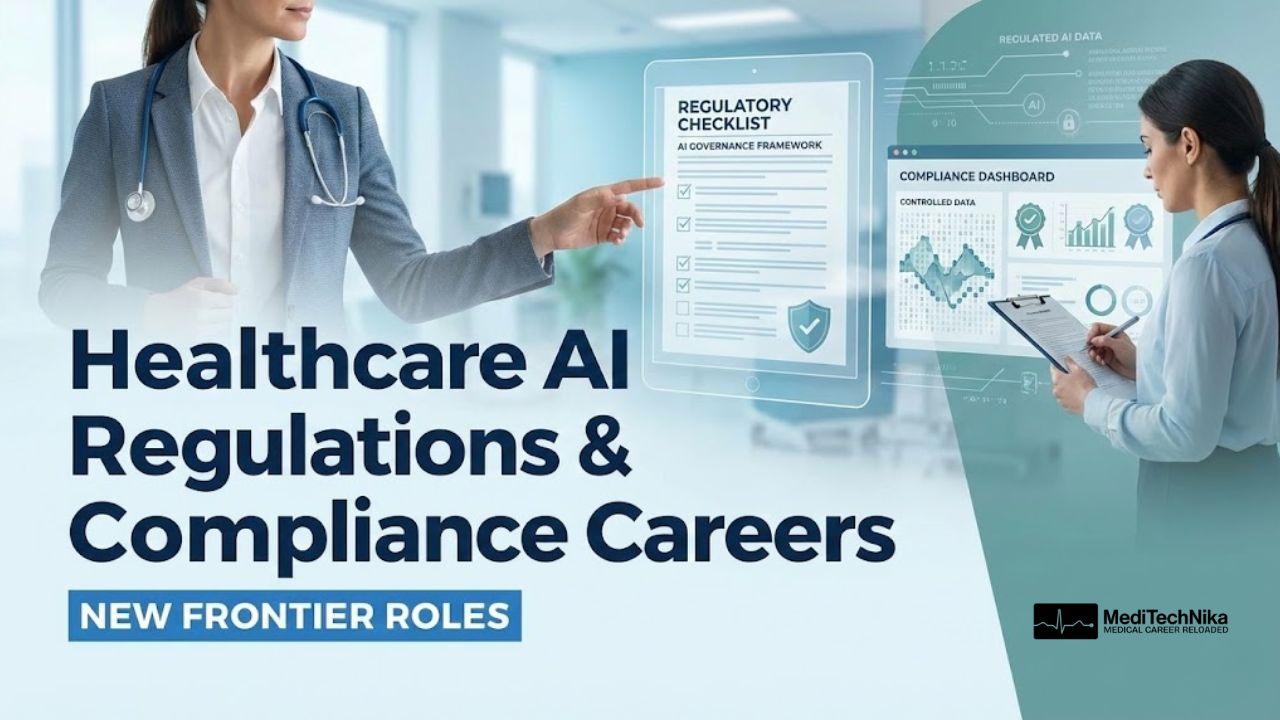
Healthcare AI Regulations & Compliance Careers
Healthcare AI: Have you ever thought about what happens when artificial intelligence starts making decisions in healthcare and who can ensure those decisions can be safe, fair, and trustworthy?
The answer is not in the technology but in the regulations, compliance, and healthcare professionals. Healthcare is all about the people and patients trusting the doctors, and we know that decisions taken by the doctors directly impact the lives of people.
Healthcare with AI is now integrated into modern medicine, which is helping us to accelerate the innovations, so strong regulations with ethical considerations and skilled professionals who can oversee whether AI is safe and responsible are needed.
Understanding Healthcare AI
Healthcare with AI is a fast-growing domain in the healthcare industry that uses artificial intelligence to support clinical decisions, diagnostics, and patient care.
To detect diseases early, for personalized treatments, and to improve the hospital workflows, AI is used. Another advantage of this is to manage the large volumes of healthcare data generated every day.
Regulations and compliance play an important role in healthcare technology to ensure patient safety, data privacy, and accountability, which can be achieved through the introduction of AI systems in healthcare.
Why Regulations Matter in Healthcare AI
We know that healthcare is a regulated industry because it directly affects human lives. When we introduce AI systems into healthcare operations, the risk becomes even higher. The decisions made by the AI can sometimes be wrong or can create errors, which can lead to misdiagnosis, wrong treatments, and no proper quality of care.
- Regulations in healthcare ensure the safety of patients by providing transparency and reliability.
- They are also involved in protecting the data generated through AI systems.
To develop and monitor medical decisions, regulators all over the world are involved in developing a strong regulatory framework.
The Growing Role of Healthcare Compliance
Healthcare compliance was involved in making sure that all the organizations were following the protocols and the standards ethically, legally, and professionally. There are a lot of areas that need to be covered by healthcare compliance to ensure data integrity and AI lifecycle management.
Patient data privacy and their consent are the major areas that need to be focused on. Along with that, we also have AI models that need to be validated before they are used in clinical practices.
Documentation is another area of AI compliance in healthcare that it covers, and the ethical use of artificial intelligence in patient care is a must that needs to be focused on.
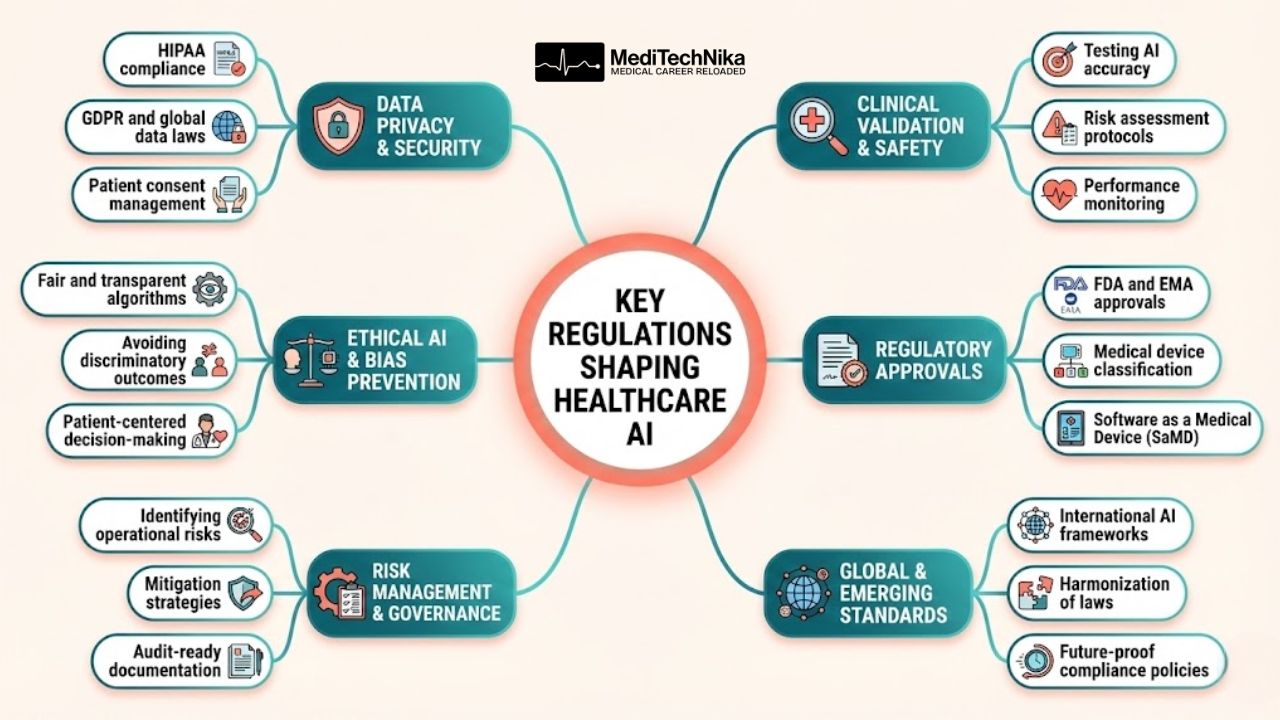
Key Regulations Shaping Healthcare
How healthcare is developed and deployed is influenced by the regional and global regulations. We also know that these laws and regulations can vary from place to place, but the core principles remain the same.
- Data protection and privacy laws: We know that every single day, a huge amount of data is being generated through the healthcare systems, and they rely heavily on the patients’ data. There is strict control over this data and its protection regarding how health data is being collected, stored, and used.
- Medical device and software regulations: Medical devices are commonly used to increase the speed of clinical workflow and efficacy, and at the same time, regulatory approvals are a must before the use of these medical devices in the hospital work environment.
- Ethical AI guidelines: Bias is a common calculated problem with the introduction of AI systems. It should be fair and explainable, and it should also be free from bias. Ethical frameworks ensure that there is no harm to the specific patient populations.
- Clinical safety and risk management: Clinical safety plays a major role in hospitals and healthcare institutions. Constant monitoring and risk assessment are needed to ensure patient safety.
How Healthcare AI is Transforming Healthcare Operations
Healthcare is now using artificial intelligence systems to improve patient outcomes and ensure patient safety. We know that there are a lot of day-to-day activities that take place in the healthcare environment that include staff and resource allocations, medical coding, and medical billing.
Every day, appointments and supply chain management. All these require a lot of people to manage, and now that AI systems have been integrated, the work becomes easy. No need to stress too much; just proper monitoring of these AI systems is enough.
As these systems are already automated, they help in automated medical coding and billing with the supply chain and logistics management. Professionals need to ensure these systems meet the regulatory and ethical standards.
Career Opportunities in Regulations and Compliance
Healthcare is expanding into different areas and continuously monitoring patient safety to ensure better patient outcomes. Along with this, there is also a scope for expanding a few career roles in healthcare regulations & compliance across the healthcare systems.
- Healthcare AI Compliance Specialist
We know that AI systems must meet the regulatory standards, and then they can be used in healthcare. These healthcare compliance specialists make sure that these systems meet regulatory requirements and review to ensure the data privacy and security standards. - AI Governance and Ethics Officer
Developing AI governance-related frameworks by addressing bias and fairness is the only work that the AI governance and ethics officer does. This role mainly focuses on the ethical and responsible use of healthcare AI. - Regulatory Affairs Professional:
Healthcare requires a regulatory affairs professional to manage the regulatory approvals and monitor the regulatory updates in healthcare. - Healthcare Technology Risk Manager
The risk manager is involved in assessing the risks that are associated with AI systems in healthcare settings. Monitors AI systems’ performance and identifies the clinical risks and operational risks. - AI Quality and Validation Specialist
The models designed and developed are tested for their quality and validated to ensure proper documentation and performance before clinical use. - Healthcare Operations and AI Policy Analyst
Developing internal AI policies and supporting the decisions made, and assessing the impact of AI in hospital workflows, is the target of a healthcare operations analyst.
Skills Required for Compliance Careers
This is a very great field for professionals and graduates who want to take up healthcare artificial intelligence as a career, and there are a lot of career opportunities. To succeed in this domain, professionals need to combine technology with healthcare and should possess strong regulatory knowledge.
- Healthcare regulations need to be understood by professionals to get into the healthcare industry AI regulations field.
- Communication and documentation skills are needed.
- Awareness regarding the governance and regulatory laws with ethical reasoning.
- Knowledge or training in the usage of AI systems.
Many upcoming roles do not always require coding but involve and focus on the validation, regulatory compliance, and governance.
Why This Career Path Is Future-Proof
Regulations and compliance will become more critical and essential as it is transforming healthcare and the workflow of hospitals. Governments, hospitals, and healthcare technology companies cannot blindly rely on these AI systems without skilled compliance professionals.
Challenges in Healthcare AI Regulations
Healthcare AI is involved in transforming and enhancing healthcare and hospitals with new discoveries and with a lot of advantages for the patients and for professionals by providing solutions to treat diseases and offering career opportunities to build a successful career.
Along with this, there are a few challenges that need to be addressed, like the lack of global regulatory standardizations, balancing innovation with patient safety, and updating the compliance framework.
These challenges further highlight the need for professionals who can guide the organizations through complexity.
Conclusion
Health AI regulations and compliance provide career paths for professionals who are interested in getting into the modern healthcare industry. For those who are looking for a meaningful and passionate career in healthcare technology and governance, this domain provides a stable and impactful career.