How AI Is Shaping MedTech Careers for Medical Graduates
AI in healthcare is transforming medicine faster than any previous technology. From AI-assisted diagnostic systems to innovative user-friendly medical devices, the healthcare system is evolving rapidly toward smarter digital tools. By 2026, MedTech career opportunities for medical graduates looking to enter technology-driven roles are expected to boom.
Suppose you want to work in healthcare setups, medical device companies, hospitals or AI-driven health platforms. In that case, the Medtech industry is offering some wonderful roles which combine innovation, technology and healthcare altogether.
Now, the medical graduates no longer have to continue the traditional pathway and limit themselves to the clinical roles. The current Medtech roles are seeking medical graduates who understand patient care and technology, as there is an increase in AI in healthcare, health monitoring devices, and digital diagnostic tools, which are used in hospitals and healthcare systems. These careers provide a stable career growth, generous pay and opportunity to work with better healthcare tools that help improve patient care.
In this article, you will learn about the Medtech jobs that are highly in demand in 2026, the technical and non-technical skills you will need to master, salary ranges, the certificates that can help you and how to start your career in healthcare.
Why AI in Healthcare Is Creating New MedTech Careers?
All the healthcare systems around the world are adapting to newer tools to decrease the time consumption, increase the efficiency and also increase the patient outcome. Especially in countries like India, the US and Europe, hospitals and start-ups are now depending on experts who can blend their clinical knowledge with the latest technologies. Certain factors that are increasing the growth of Medtech are:
- Use of AI in diagnostics
- An expanding number of wearable devices and medical equipment
- The increasing number of start-ups and raising funds
- Digital shift in hospitals for better patient care and monitoring
- Need for products that are evidence-based and follow regulatory compliance
For the rising medical graduates, this creates a perfect opportunity to blend their clinical knowledge in this field.
Top MedTech Careers Emerging from AI in Healthcare (2026)
A few career roles that are in high demand at hospitals, digital health start-ups and device companies are listed below.
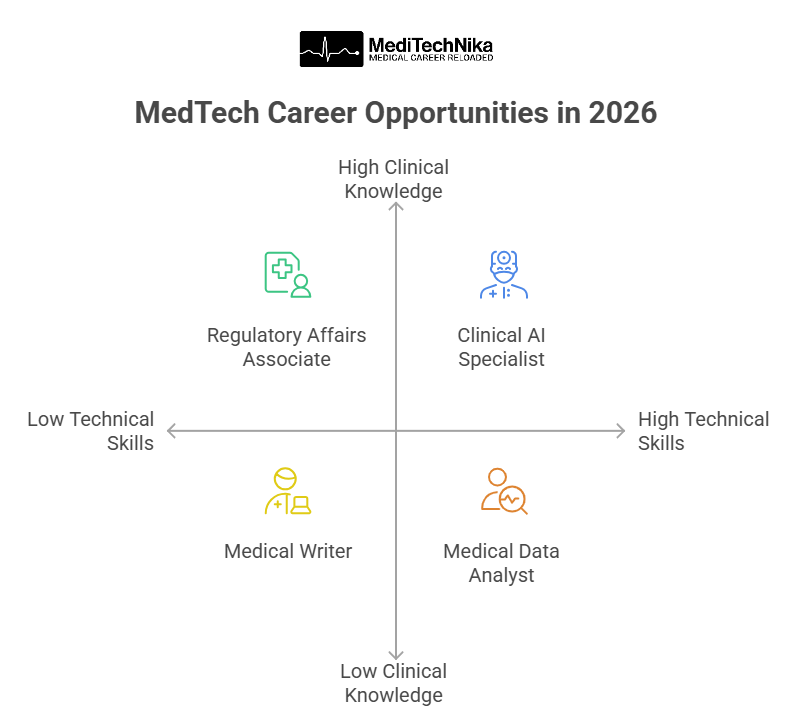
1. Clinical AI Specialist Intern/Trainee
Where can you work?
Start-ups for AI healthcare, diagnostic AI companies, telemedicine platforms, and innovation teams at hospitals
What you do:
- Support in combining AI tools with clinical trials by providing ideas and helping in design, testing
- Review the medical data sets which is used for training the AI models
- Work with the data teams, doctors and the product launching team
Why is this in demand?
Because hospitals are in need of safe, quick and reliable AI tools.
Who is it best for?
Graduates from MBBS, BDS and BPT degrees who are interested in technology can fit into this role.
Salary Range (India – entry): ₹4-7 LPA
Mid-level: ₹8-15 LPA
Global Entry: US$45,000-60,000/year
2. Medical Data Analyst/ Healthcare Data Analyst
Where can you work?
Hospitals, MedTech platforms, device companies
What you do:
- Analyse the clinical data
- Identify the patient workflow issues and modern trends
- Support AI/ML model building
Skills needed: Data analytics, basic Python, medical coding, healthcare data standards (HL7, FHIR)
Salary Range (India – entry): ₹3-6 LPA
Global Entry: US$45,000-55,000/year
3. Regulatory & Clinical Affairs Associate
Where can you work?
Medical device companies, MedTech start-ups, pharma-tech
What you do:
- Prepare necessary documents for AI based devices
- Manage the ethical submission of documents
- Ensure that the product meets the safety guidelines
Why is it important?
Every product must meet the safety standards before reaching the market.
Salary Range (India – entry): ₹4-6 LPA
Global Entry: US$40,000-55,000/year
4. Digital Health Product Analyst/Coordinator
Where can you work?
Health-tech start-ups, telemedicine apps, AI platforms, EHR companies
What you do:
- Gather clinical and product requirements
- Assist PMs with documentation and product planning
- Coordinate between tech, design, and clinical teams
- Ensure clinical usability feedback reaches the product team
Why do medical graduates fit into this role?
You have better clinical understanding and user empathy.
Salary Range (India – entry/junior PM): ₹4-7 LPA
Global Entry: US$55,000-75,000/year
5. Clinical Implementation Specialist
Where can you work?
Hospitals, MedTech device companies, and diagnostic robotics companies.
What you do:
- Help hospitals to adopt new medical software and devices
- Train doctors and nurses
- Resolve the clinical issues
Salary Range (India – entry): ₹3-5 LPA
Global Entry: US$40,000-50,000/year
6. Medical Writer (Scientific & Regulatory)
Where can you work?
MedTech companies, CROs, health-tech platforms
What you do:
- Create regulatory documents
- Develop scientific content
- Write clinical evaluations and device reports
Salary Range (India – entry): ₹3.5-6 LPA
Global Entry: US$45,000-60,000/year
7. UX Researcher for Healthcare
Where can you work?
Digital health apps, AI companies, EHR platforms.
What you do:
- Learn how clinicians and patients use the digital tools available
- Making digital health tools, apps and devices user-friendly for patients
Skills that are in Demand for MedTech Careers in 2026
You will need a mix of technical and non-technical skills to build your career in current healthcare technology. Some skills that you may need to work in the healthcare sector are:
Technical Skills
AI & Machine Learning Basics (Beginner-Friendly)
Knowing this technical skill does not mean you have to learn advanced coding; you just have to understand:
- What AI models do
- How the medical data is used
- Common risks that may occur regarding safety issues and errors
Data Handling & Technology
- Basic Python Skills
- SQL
- Data visualization
- Healthcare Data Standards like HL7, FHIR, DICOM
Digital Healthcare Tools
- Electronic medical records
- Remote monitoring platforms
- Clinical decision support systems
Knowledge Regarding Regulatory and Compliance
Having this knowledge will help you boost your career:
- CDSCO India guidelines
- FDA SaMD (Software as a Medical Device)
- MDR (European regulation)
- ISO 13485, ISO 14971
Non-Technical Skills
These skills are very beneficial in AI-related Medtech roles
- Clear clinical communication
- Understanding the workflow
- Problem-solving
- Team collaboration
- Documentation
Medical graduates already gain these soft skills, which act as a plus point in the healthcare sector.
Career Pathways (Entry → Mid → Senior)
AI Clinical Pathway
- Entry: Clinical Annotator → Medical Data Associate
- Mid: Clinical AI Specialist
- Senior: AI Validation Expert → Clinical AI Lead
Product Pathway (Digital Healthcare Systems)
- Entry: Product Analyst/Associate
- Mid: Product Manager
- Senior: Director of the Product → Chief Product Officer
Regulatory & Clinical Affairs Pathway
- Entry: Regulatory Associate
- Mid: Clinical Affairs Specialist
- Senior: Regulatory Manager/Quality Director
Health Tech Start-up Pathway
- Entry: Clinical Operations/Analyst
- Mid: Product Role/Growth Strategist
- Senior: Clinical Director → Start-up founder/co-founder
Certificates That Can Strengthen Your Profile
You will not have to pursue long degrees to know about AI and how AI is transforming the healthcare sector; it’s right next to you. Just scroll your phone and enrol in the top course providing platforms to upskill yourself. Short courses can provide you long term benefits. Some courses that might help you are:
AI & Data
- Biotecnika
- Data Analytics – Certification by Google
- Data Science Course by Harvard University
Product & Digital Health
- Digital Health Transformations (HIMMS)
- Product Management Course by Duke University
MedTech Regulatory
- ISO 13485 by British Standards Institution
- Medical Device Regulatory Affairs training by IGMPI
Salary Trends in MedTech & AI Healthcare Careers (2026)
Overall trends:
- With the increasing number of AI start-ups, the demand increases, hence the salary growth
- Regulatory, data and product roles have a faster rate of salary increments
- Start-ups offer
- MedTech start-ups offer ESOPs and quick promotions
- Hospitals and companies are offering higher salaries to digital health roles to attract more talent and higher outcomes
Expected Salary Growth (2024–2026):
There is a 20-40% increase in digital health and MedTech roles all over India and global markets.
How Can Medical Graduates Enter MedTech in 2026

Step 1: Pick your pathway
AI Clinical | Data Analytics | Product | Regulatory | Writing
Step 2: Take up Beginner Friendly Courses
Choose between AI basics, Data Analytics, Product, or Regulatory Courses.
Step 3: Build a Small Portfolio
Case studies: workflow mapping, data cleaning tasks, product ideas.
Step 4: Start with Internships and Grow Eventually
- Health Tech start-ups offer internships to beginners and help in your growth.
- Hospitals with digital transformational teams
- Medical Device companies take innovative freshers and help execute their ideas.
Step 5: Highlight Your Clinical Knowledge
Your medical knowledge will give you an upper hand while choosing the field you are interested in.
Conclusion
AI in healthcare is not only changing the medical industry, but it is also creating a new world for medical graduates to pursue MedTech careers. By 2026, the global rise in demand for professionals who can blend technology with patient care will increase rapidly than ever.
With the right skills for patient care, AI data, regulatory knowledge and newer tools in the market, you can build your rewarding career with high salaries, global opportunities and contribute to the future of the healthcare sector.