AI in Healthcare: How AI-Powered Diagnostic Tools Are Transforming Clinical Decision-Making
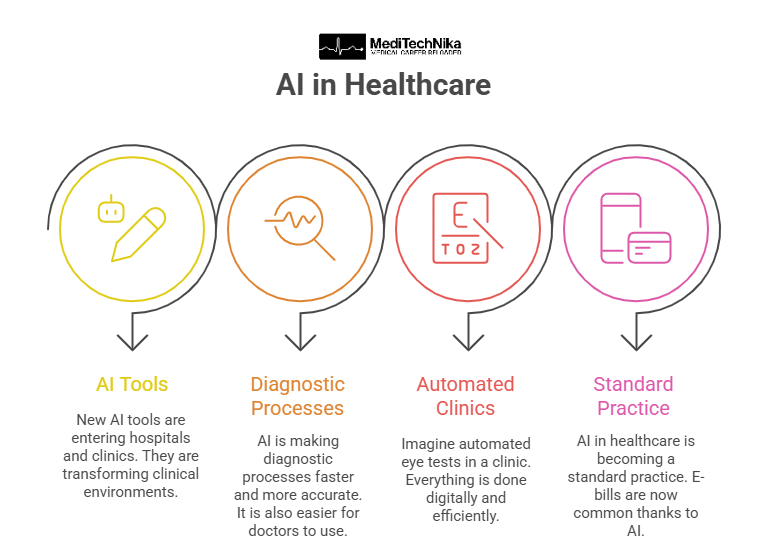
Artificial Intelligence is becoming one of the most powerful developments to take place in the modern medicine sector. Every year, new AI tools are being created, entering hospitals, clinics, labs, and diagnostic centres. AI in healthcare is no longer a futuristic concept for medical graduates; it is already transforming real clinical environments. It is shaping how diseases are detected and treated, making diagnostic processes faster, more accurate, and easier for doctors through AI medical diagnosis systems powered by advanced machine learning healthcare models.
Imagine entering a clinic to get your eye tested and everything is automated and done digitally. You just have to answer a few questions and be seated, everything comes right to you. That is how fast and easy the AI has made it. Who would have thought that e-bills could come to you a decade ago? It would all sound fictional. Today, thanks to AI in healthcare, it is becoming a standard practice.
In this article, we will learn how to explore and learn about the AI-powered diagnostic tools and why they are becoming essential now, and what this means to future healthcare professionals.
The Rise of AI in Healthcare: Why Now?
For decades, the healthcare industry has struggled with a few challenges:
- Increasing patient numbers
- Shortage of specialists or doctors
- Higher rate of delay in diagnosing
- Changes in clinical judgement
- High demand for personalised care
AI technologies, especially machine learning healthcare tools, are helping a lot to overcome these challenges. These systems can handle large amounts of data, scans, lab reports, patient histories, and identifying patterns that the human eye cannot immediately recognise.
Unlike traditional software tools, AI learns new things with every new data, improving the accuracy of AI medical diagnosis. This is why AI medical diagnosis is becoming a game-changer in modern hospitals.
How AI-Powered Diagnostic Tools Work
To understand the AI diagnostics, imagine that you are teaching a student how to read a chest X-ray. You show multiple images of healthy and unhealthy lungs and point out how to detect pneumonia, TB, fibrosis, or nodules, and slowly, the student learns to detect the signs. AI learns it the same way.
- Training Phase:
Millions of data sets are fed into the system with labeled images and clinical cases. - Pattern Recognition:
The AI model will study these examples, find and recognise the relationships and features that will differentiate the healthy ones from the unhealthy ones. - Prediction/Diagnostic Phase:
Once the models are trained, AI will analyze new images/ patient data and provide the risk factor along with the diagnosis. - Continuous Learning:
Over time, the system will improve as more cases are fed into it.
AI doesn’t replace medical reasoning; it enhances clinical decision-making by providing more accurate, consistent, and fast analysis.
AI in Medical Imaging: The Most Active Area of Diagnostics
Medical imaging is currently the most advanced application of AI in healthcare. Tools based on deep learning are now assisting radiologists by detecting abnormalities that might have been missed during a busy clinical day.
1. AI in Radiology
AI tools can detect:
- Lung nodules in CT scans
- Breast lesions in mammograms
- Stroke indicators in MRI
- Bone fractures in X-rays
- Liver lesions in ultrasound
In many hospitals, AI systems are able to read the critical scans in seconds, so now radiologists can focus on more urgent cases. For example, some AI models are able to detect breast cancer more accurately. Then imagine what would happen when radiologists and AI both work together. It is already said that nothing can beat a human brain. Now, the human brain, along with the human-made AI, can make the diagnosis faster and more accurately.
2. AI in Ophthalmology
AI models can detect:
- Diabetic retinopathy
- Glaucoma
- Age-related macular degeneration
This detection is very helpful in areas with fewer ophthalmologists. The AI tools have already reached the community health centres, making diagnosis easier.
3. AI in Pathology
Digital pathology combined with machine learning healthcare systems can:
- Identify cancerous cells
- Grade tumors
- Detect rare abnormalities
- Quantify immunohistochemistry markers
This increases the accuracy and reduces the chances of different opinions.
AI Beyond Imaging: Expanding the Diagnostic Horizon
4. AI in Cardiology
AI is now used to analyze:
- ECGs
- Echocardiograms
- Cardiac MRIs
Some AI tools can now detect early arrhythmias or predict heart failure symptoms before they appear. AI-based ECG detection is becoming a standard practice in many healthcare systems, enhancing clinical decision support systems used in cardiac care.
5. AI in Laboratory Diagnostics
Machine learning systems can:
- Read blood test trends
- Predict the risk of disease (like sepsis or AKI)
- Identify abnormal cell functions
AI also helps automate lab workflows, reducing the time required by traditional methods.
6. AI in Clinical Decision Support Systems (CDS)
AI-powered clinical decision support systems integrate:
- Electronic health records (EHRs)
- Medication histories
- Vital signs
- Comorbidities
- Diagnostic reports
Then they also provide suggestions such as:
- Possible diagnostic methods
- Recommendations for treatment
- Drug-drug interactions
- The extent of the risk
These tools will help clinicians make faster and safer decisions, especially in busy hospitals with high patient numbers.
How AI is helping Us in Clinical Decision-Making
1. More Accuracy
AI models usually perform better than traditional diagnostic systems in detecting small abnormalities. A tiny lung nodule cannot be detected easily with the human eye but it can be spotted easily by AI.
2. Faster Diagnosis
AI can detect abnormalities in scans in seconds. In emergency units, such as stroke and trauma care, this speed can help save a number of lives.
3. Reduced Human Error
Even the best doctors can miss out on small symptoms that appear and lead to huge problems. AI can provide continuous second opinions on such cases.
4. Better Risk Prediction
Many AI medical diagnosis tools can detect complications like sepsis and heart failure hours before the symptoms start appearing. This speed is very much necessary to treat and save the lives of patients.
5. Improved Workflow Ability
AI automates regular tasks like measurements and reporting data. This provides clinicians with more time to spend with patients.
6. Accessible Expertise
AI makes high-quality diagnosis possible even in areas where resources are limited. This would help on a large scale.
Real-World Examples of AI in Healthcare
- Detection of Stroke: AI tools are now identifying intracranial hemorrhage or large vessel occlusion in minutes and alerting the stroke teams.
- Breast Cancer Screening: AI screening reduces the workload on radiologists.
- Dermatology: AI apps can detect skin lesions with high accuracy.
- Pediatric Diagnostics: AI helps in detecting congenital conditions by analyzing the ultrasound scans and fetal images.
- COVID-19: AI-assisted CT reading helped a lot during the pandemic.
These are not experimental now; they are already used in hospitals in large amounts worldwide.
How can Medical Graduates Prepare for an AI-Integrated Future
AI is not here to replace the roles of healthcare professionals, but is here to empower them and help them. As future clinicians and medical representatives, graduates should develop:
1. Digital Literacy
Basic understanding of:
- AI concepts
- Data interpretation
- Digital health tools
2. Ability to Work with AI Tools
Knowing how to read AI output and integrate it with clinical reasoning will be essential.
3. Critical Thinking
AI can guide, but clinicians must make the final call.
4. Continuous Learning
AI in healthcare evolves rapidly. Staying updated is part of modern medical practice.
Conclusion: AI Is a Partner, Not a Replacement
AI-powered diagnostic tools are redefining clinical decision-making with improved accuracy, speed, and efficiency. For medical and healthcare graduates, this shift represents an exciting opportunity. Instead of fearing AI, embracing it will make you a stronger, more capable clinician.
The future of healthcare lies in the collaboration between human expertise and artificial intelligence – combining the best of both worlds to deliver safer, faster, and more personalized patient care.