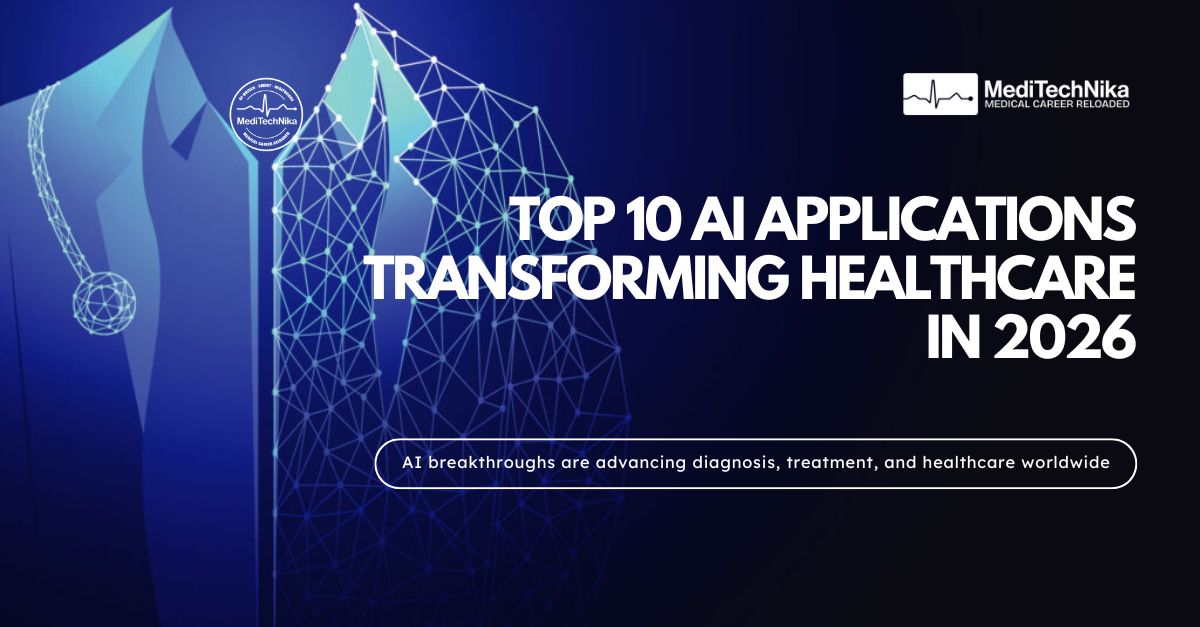
AI IN HEALTHCARE: TOP 10 AI APPLICATIONS TRANSFORMING HEALTHCARE IN 2026
AI in Healthcare: In 2026, the growth of AI in healthcare and medicine marks a defining moment. Artificial intelligence not only assists healthcare and medicine but also empowers them. From the detection of cancer in seconds to guiding patients in recovery through virtual assistance with the AI algorithms, technology has become a boon to global healthcare.
Among the research labs and hospitals, AI is making things faster, more precise, and smarter, where AI-powered diagnostic systems are being used from hospitals to medical AI startups to predict diseases and transform every layer of healthcare by designing next-generation tools.
Here are the top 10 AI applications listed below that are transforming healthcare in 2026:
AI-POWERED MEDICAL IMAGING AND DIAGNOSIS:
One of the most notable recent innovations in AI in healthcare is its role in imaging and diagnostics. Machine learning systems now analyze CTs, X-rays, MRIs, and other scans by spotting variations faster with accuracy.
For example, AI tools are already assisting doctors in detecting fractures and diseases (such as early detection of cancers, neurological disorders, or internal bleeding) and supporting sustainable development. Technology is rapidly advancing, particularly in the healthcare sector.
For medical AI startups, this would be a great opportunity where companies are building platforms that combine medical knowledge with AI models to support doctors and clinicians. Early and accurate detection, followed by diagnosis, helps to save lives and also reduces costs.
- PERSONALIZED MEDICINE & PRECISION CARE
Personalized medicine is another major application in the field of healthcare that transforms the perspective of diagnosis, and the way of treatment that will be tailored to patients is going to be another breakthrough in 2026. AI in medicine has the capacity to analyze genetic data, medical history, lifestyle, and other inputs that enable it to design individual treatment plans.
By this, the patients receive precise treatment based on their genetic makeup, past responses, with a better outcome, reducing the side effects. Medical start-ups are combining genomics, proteomics, and patient databases to make the diagnosis much better and in an easier way.
- ACCELERATED DRUG DISCOVERY & DEVELOPMENT
AI in healthcare is also getting extended into the biotech and pharma domains. This is also transforming the field of how the drug is being discovered by predicting the molecular interactions and analyzing the drug-target responses. AI in drug discovery analyzes the huge datasets from medical research and biological pathways. This helps to reduce the cost and time by identifying the promising drug candidate to bring the novel drugs to the market for better treatment, especially personalized treatment, and would also lead to better outcomes in clinical trials.
- VIRTUAL HEALTH ASSISTANCE & CHATBOTS
Another feature of AI in healthcare is virtual assistance and chatbots. This feature helps to schedule appointments and also interact with patients and help manage care with human involvement. In the field of medicine, this involves primary care and continuous patient commitment.
Medical startups are now using various platforms for multidimensional and multilingual interactions, using NLP methods and AI/deep learning models. This reduces clinical burden and improves patient care.
- PREDICTIVE ANALYTICS & RISK STRATIFICATION
AI in healthcare can predict adverse events like disease onsets or complications before they occur. This allows hospitals and systems to mediate proactively and focus on analytical platforms that are growing rapidly. This enables real-time monitoring, integrating wearables, and predicting population health.
- REMOTE MONITORING & TELEHEALTH EXPANSION
AI in healthcare has enabled remote monitoring of patients through connected devices and wearables. With this, chronic diseases can be managed at home, which reduces hospital visits by improving patients’ independence.
Medical startups are designing platforms using AI that tie sensor data, AI insights, and care delivery with better access and lower cost.
- ROBOTIC SURGERY & INTERVENTIONAL AI
Robotic surgery is another breakthrough innovation in healthcare, where robots are guided by AI algorithms, empowering next-generation surgical systems for precision, less invasiveness, and better outcomes.
This creates a key opportunity for autonomous or semi-autonomous surgery and remote/telesurgery with high precision, fewer complications, and faster recovery. But this includes high cost with regulatory and clinical trial burdens, surgeon training, and acceptance.
- CLINICAL DOCUMENTATION & ADMINISTRATIVE AUTOMATION
AI in healthcare is now relieving administrative burdens by transcribing notes, automating workflows, billing/coding, and summarizing visits. This makes clinicians focus more on patients and less on paperwork. Medical startups are delivering “medical scribe” and automation tools integrated with EHRs with the help of artificial intelligence.
Hence, this reduces clinical burden, leading to fewer errors with improved efficiency. One important thing to note is accuracy (mistakes/errors in documentation can harm care), ensuring data security, and privacy.
- WORKFLOW OPTIMIZATION & HOSPITAL OPERATIONS
In medicine, it includes smoother operations with fewer delays, less waste, and better outcomes. AI in healthcare is also transforming hospital operations like staffing, supply chain, patient flow, and bed logistics.
Workflow optimization and hospital operations matter because of lower operational costs, improved service delivery, and better resource utilization. There might be a few data integration challenges that need to be taken care of.
- ETHICS, BIAS MITIGATION & REGULATORY AI
It is critical to ensure the ethics, fairness, transparency, and regulatory dimensions of AI in medicine. Especially for medical startups, building compliant and ethical solutions is not optional but is foundational for trust and long-term success. Without safety, trust, and fairness, AI adoption will stall or harm patients.
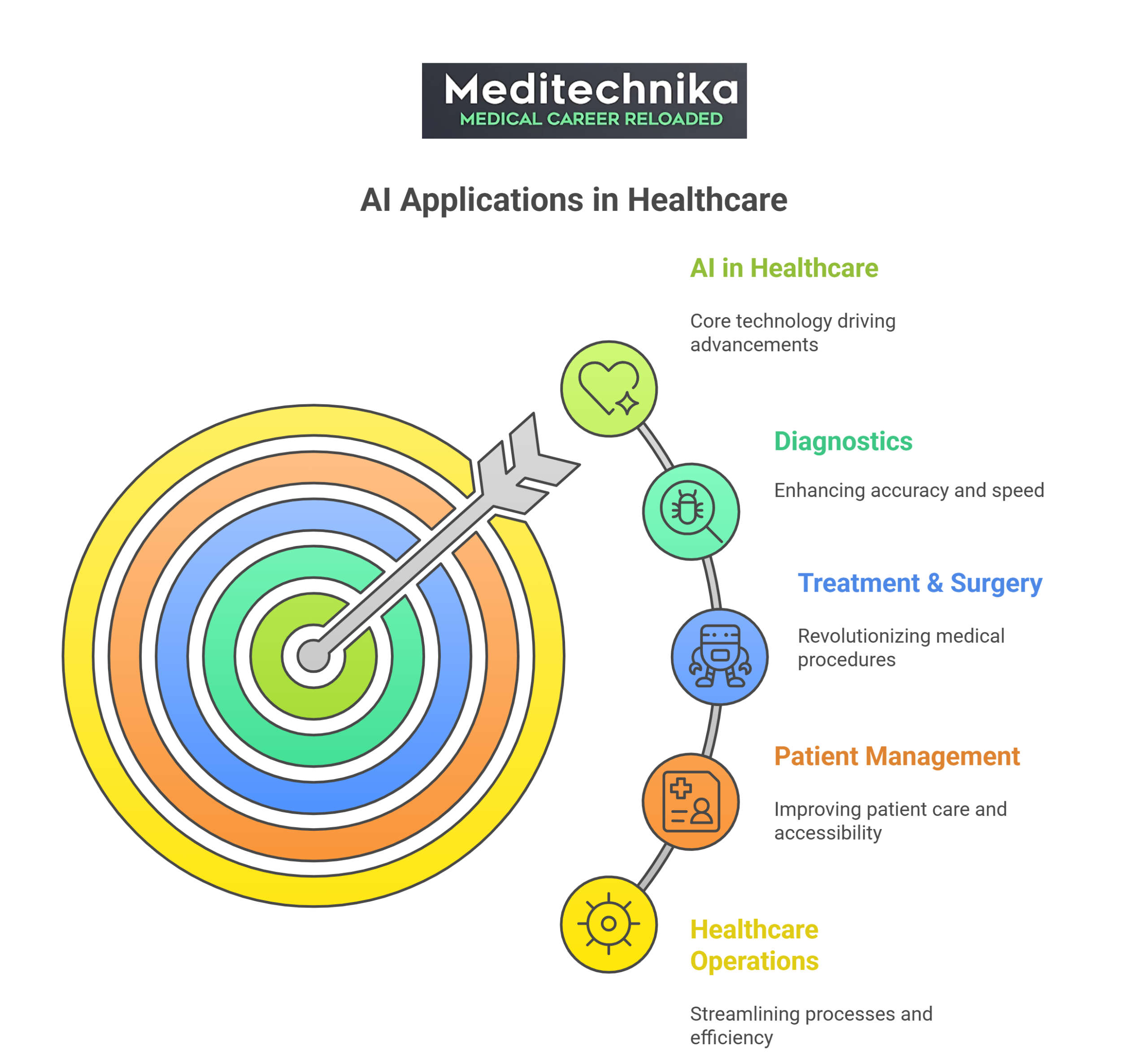
There are many advantages of artificial intelligence for a sustainable human life. Despite its promise, AI adoption in healthcare faces problems like data privacy, algorithmic bias, and regulatory complexities. These obstacles are being addressed through ethical AI design and robust validation studies.
As a caregiver or patient, the human impact of AI in healthcare and medicine is more accessible, smarter, and more personalized. For investors or funding agencies, understanding how AI in medicine can transform systems is the key to funding decision planning and regulation. If you are in healthcare, medicine, technology, or entrepreneurship, this would be one of the most dynamic sectors right now.
AI in medicine and healthcare is transforming the way we examine and treat. The transformation of healthcare in 2026 is powered by human intelligence and artificial intelligence.