

MBBS Jobs for Freshers in India
Are you an MBBS graduate exploring your first career opportunity? An MBBS qualification can lead to roles in hospitals, government health services, clinical research, public health, insurance, occupational health, telemedicine, and other areas of healthcare.
An MBBS degree can take you further than you realise. From renowned hospitals and government institutions to research organisations, startups, MNC Companies, and global healthcare firms, MBBS Freshers find more career opportunities than ever before.
This article will help you understand the best MBBS jobs for Freshers, expected salary ranges, top hospitals actively hiring, what are all the eligibility requirements, career growth opportunities, and practical tips to land your first medical job soon
Why Can Finding Your First Job After MBBS Be Challenging?
India has made progress in its overall doctor availability, but healthcare workforce gaps can still vary, particularly in rural healthcare, emergency medicine, preventive healthcare, occupational health, and public health programs. However, the healthcare workforce shortages can vary widely depending on geography, healthcare settings, specialities, and availability of government jobs in rural areas.
On the other hand, the MBBS graduates entering the workforce may have to compete for certain jobs as well as wonder whether to continue studying postgraduate studies or not.
Some of the common challenges are:
- Limited awareness about career options beyond residency.
- Limited independent clinical experience after internship.
- Competition for government vacancies.
- Confusion between preparing for PG and taking up jobs.
- Limited exposure to corporate healthcare careers.
Hospitals, research organisations, pharmaceutical companies, telemedicine providers, insurance organisations, public-health programmes, and other healthcare employers periodically hire MBBS graduates.
You just have to look for which role aligns with your interests and long-term goals.
MBBS Jobs for Freshers: Salary Breakdown (2026)
Salaries for MBBS graduates vary depending on the role, institution, location, experience and allowances. Government positions may follow a prescribed pay scale matrix, while private positions offer salaries determined by the individual employers.
Government Sector Salary
Government jobs after MBBS come with structured pay scales. Government Jobs offer regular, contractual, ad-hoc, residency-based, or program-specific positions. So, the salary structures differ depending on positions. Some roles follow the pay scale range, whereas others offer a consolidated salary. Candidates could check the official recruitment notification for the latest salary, tenure, and allowances.
Private Sector Salary
Salaries for MBBS freshers in private hospitals and healthcare organisations are not standardised. Salaries depend on organisation, location, experience, shift pattern, and responsibilities. Candidates could confirm the compensation, working hours, benefits, and terms directly from the employer or current job posting before accepting an offer.
City-Wise Reality
But the Location changes everything. A fresher working in Mumbai, Delhi, or Bengaluru can expect salaries 20–50% higher than someone in a smaller town. But smaller cities and rural postings often come with incentives, free accommodation, or bond-linked bonuses that quietly close the gap.
Salary Breakdown
| Sector | Monthly Salary Range |
| Government Hospital | ₹45,000 – ₹80,000 |
| Private Hospital (Tier 1 city) | ₹40,000 – ₹90,000 |
| Private Hospital (Tier 2/3 city) | ₹30,000 – ₹60,000 |
| Corporate Chains (Apollo, Fortis, Max) | ₹60,000 – ₹1,20,000 |
Salary varies depending on organization, city, experience, and additional certifications.
Eligibility for MBBS Jobs for Freshers
Eligibility requirements vary according to the post and the recruiter. The common requirement for clinical posts is possession of a valid MBBS degree, completion of the necessary rotating internship, and registration for practice as a physician.
Further age restrictions, state registration, internship completion, experience, certification, or other institution-related criteria may be specified by the employer. Recruitment through the government will further have additional eligibility requirements as mentioned in the recruitment notice.
Always look at the recruitment notice separately rather than assuming that being in possession of an MBBS degree makes one eligible for all clinical positions.
Clinical Jobs for MBBS Freshers
When freshers hear “MBBS jobs,” they usually picture only one thing — becoming a full consultant. In reality, jobs after MBBS come in layers. There are multiple layers of career opportunities for Fresh MBBS Graduates depending on their interests, career goals, and preferred work environment.
-
Junior Resident:
- Junior Resident Positions are early-career pathways for MBBS graduates in hospitals and government institutes.
- One of the most popular MBBS Freshers Jobs where you will work under Senior Consultants and be trained for different specialties such as Medicine, Surgery, Pediatrics, Orthopedics, Obstetrics & Gynecology, Emergency Medicine, and Psychiatry.
- You will be responsible for patient examination, ward rounds, assisting surgeries, maintaining medical records, emergency care, and clinical documentation.
-
Medical Officer:
- Medical Officer Positions are available across different healthcare settings.
- They are responsible for providing primary healthcare services, supervising healthcare teams, and managing patient care in hospitals, community health centers, and government facilities.
- They do disease diagnosis, prescribe treatment, manage emergencies, provide healthcare awareness activities, and provide patient consulting.
-
Casualty Medical Officer:
- One of the fast-paced career options for fresh MBBS graduates is Emergency Medicine.
- Casualty Medical Officers handle emergency cases, trauma patients, poisoning, cardiac emergencies, road traffic accidents, and critical care stabilization.
- MBBS Freshers who are willing to take a role in emergency care need to have skills like quick decision-making, basic life support, advanced cardiac life support, communication, and stress management.
-
Critical Care Medical Officer:
- Some healthcare settings consider MBBS graduates for junior ICU or critical care positions under senior supervision.
- They assist with patient monitoring, clinical documentation, rounds, communication with senior clinicians, and other assigned patient-care duties.
- Critically ill patients and procedures requiring advanced clinical expertise should be managed under the particular healthcare professional’s supervision.
Career Options After MBBS Beyond Hospital-Based Clinical Roles
Most of your Seniors do not explain to you about a career beyond the stethoscope and hospital wards. MBBS graduates explore careers beyond hospital-based clinical roles. Here are a few careers you would love to explore:
-
Clinical Research Physician:
- Clinical Research Physicians work on clinical trials, patient safety, protocol implementation, and regulatory compliance.
- They make sure to monitor clinical trials, safety reporting, and review medical reports
- Pharmaceutical Companies, Contract Research Organisations, Hospitals, and Academic Institutions employ doctors in clinical research, medical safety, and related functions depending on the skills.
-
Public Health Medical Officer:
- Doctors who are most interested in Community and Public Health care rather than hospital-based care choose to be Public Health Medical Officers.
- They contribute to disease surveillance, awareness and immunisation campaigns, maternal and child health programs, disease outbreak investigations, and preventive healthcare initiatives.
- Opportunities are available at National Health Mission (NHM), State Health Departments, District Health Offices, International NGOs, and Public health organisations for this role.
-
Insurance Medical Officer:
- Health Insurance Medical Officers are often involved in healthcare claims, evaluating health claims, reviewing treatment records, and ensuring policy compliance.
-
Occupational Health Physician:
- Large industries, manufacturing plants, IT companies, oil & gas organisations, and multinational corporations hire MBBS graduates to oversee employee health and workplace safety.
- They are responsible for Employee health assessments, Fitness-for-duty evaluations, Workplace injury management, Preventive health programs, and Occupational disease surveillance
- The job requirements of occupational health jobs depend on the industry or business, the type of employer and the regulatory standards that apply. Some medical jobs in industries or factories may have special qualifications in occupational health and experience in addition to those in AFIH, based on the industry or factory and regulations.
-
Telemedicine Consultant:
- Digital Healthcare has created new MBBS Jobs for Freshers post-pandemic.
- Telemedicine platforms allow doctors and medical practitioners to provide patient care remotely.
- Doctors need to adhere to the relevant medical registration laws, professional requirements, ethical standards, documentation, prescribing, and telemedicine guidelines, since telemedicine falls under medical practice.
- MBBS graduates should be aware of the criteria at each workplace before applying, as different workplaces will have different eligibility criteria and working conditions.
Hospitals and Employers to Monitor For MBBS Jobs
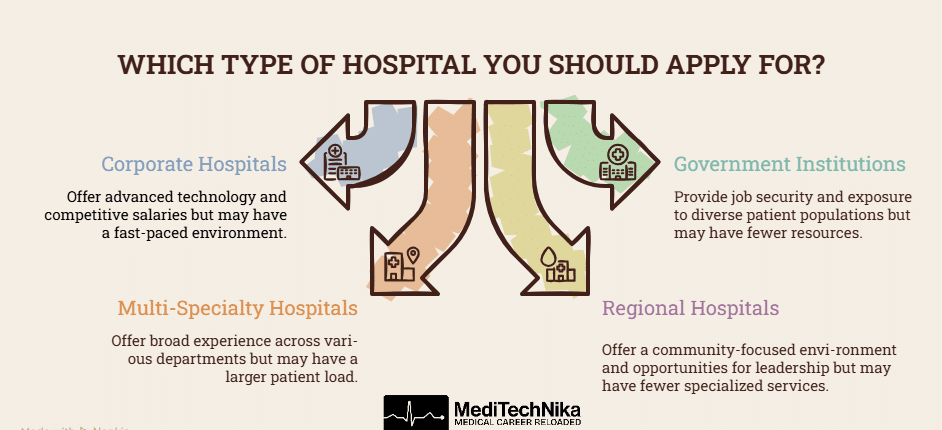
- Corporate Hospitals – Apollo Hospitals, Fortis Healthcare, Max Healthcare, Manipal Hospitals, Medanta, and Narayana Health advertise positions for which MBBS graduates are eligible. They often run structured hiring drives, especially around internship completion season.
- Government Institutions – Institutions such as AIIMS, PGIMER, JIPMER, NIMHANS, Tata Memorial Centre, state health departments, government hospitals, and other public healthcare organisations may advertise Junior Resident, Medical Officer, and other MBBS-eligible positions. Recruitment methods and eligibility requirements often differ between institutions and vacancies.
- Multi-Specialty and Regional Hospitals – Hundreds of regional hospitals and nursing homes post Junior Resident openings. Apart from Well-known hospitals, they often welcome freshers in departments like general medicine, emergency, and critical care.

Where can you search? — Candidates can look for notifications from official hospital career pages, government recruitment portals, state health department websites, institutional recruitment pages, and reputable healthcare job platforms. These are the most reliable sources to get a job. MediTechNika can also be used to discover relevant healthcare and medical job updates.
Skills Employers Look for in MBBS Freshers
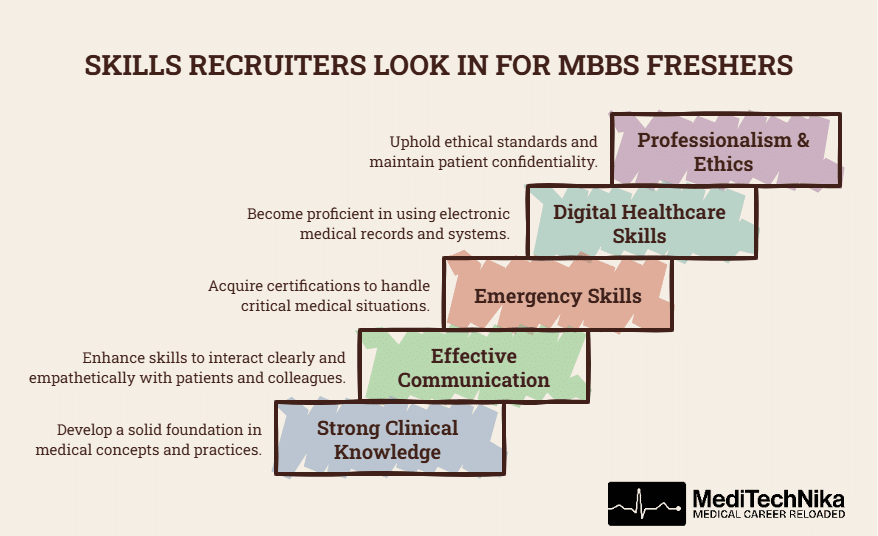
Having an MBBS degree is the first step, but recruiters also look for practical and professional skills. Some of the skills that make you stand out from the crowd are:
-
- Strong Clinical Knowledge – Fresh MBBS Graduates must know about clinical examination, differential diagnosis, evidence-based clinical assessment and management appropriate to the doctor’s level of training, scope of practice, and institutional protocols.
- Effective Communication Skills – Clear communication helps build trust and improve patient care. Doctors should communicate with patients, fellow doctors, and senior doctors better.
- Emergency and Critical Skills – Recognized and role relevant certifications such as Basic Life Support (BLS), Advanced Cardiovascular Life Support (ACLS), and Basic Trauma Life Support (BTLS) may strengthen preparedness for emergency-facing positions, particularly where such training is requested or preferred by the employer.
- Digital Healthcare Skills – Hospitals use electronic medical records (EMRs) and hospital information systems. You should be familiar with digital healthcare tools.
- Professionalism and Ethics – Recruiters expect medical professionals to maintain patient confidentiality, follow ethical rules, and demonstrate empathy.

How to Improve Your Employability After MBBS?
Getting your first job after completion of MBBS is not just about applying. Below are the ways you can enhance your employability;
Gain Relevant Certifications
Short-term certifications can strengthen your profile. Consider courses in:
- Basic Life Support (BLS)
- Advanced Cardiovascular Life Support (ACLS)
- Clinical Research
- Good Clinical Practice (GCP)
- Infection Prevention and Control
- Occupational Health
- Medical Writing
Be Flexible About Location
Opportunities may also be available in district hospitals, rural healthcare facilities, and tier-2 or tier-3 cities. Consider location alongside factors such as role responsibilities, supervision, learning opportunities, remuneration, accommodation, contract terms, and your longer-term career plans.
Build Your Professional Network
Networking often leads to opportunities that are not publicly advertised. Stay connected with:
- Professors and mentors
- Internship supervisors
- Senior residents
- Alumni
- Medical associations
- Healthcare conferences and workshops
Keep Learning
Continuous learning reflects a positive attitude toward professional development. Healthcare evolves rapidly. Stay updated with:
- Clinical guidelines
- National treatment protocols
- Medical journals
- Continuing Medical Education (CME) programs
- Online learning platform
FAQs
- Which jobs can I do after MBBS without PG?
With eligibility, the MBBS graduate might consider becoming a Junior Resident, Medical Officer, taking care of emergency services, pursuing a career in public health, clinical research, medical insurance, telemedicine, medical writing, and various others.
- Can MBBS graduates work in clinical research or telemedicine?
Research-oriented jobs may require knowledge of GCP guidelines, research experience, and clinical experience. Any form of telemedicine that involves the treatment of patients needs to have proper medical registration.
- What is the salary of an MBBS fresher in India?
The pay for each fresher having done MBBS is not fixed in one go. The pay will depend on various factors like the nature of the job, employer, area, experience, type of engagement, time of work, and allowances.
- Is internship completion required before taking up a clinical job after MBBS?
For clinical patient-care roles, candidates generally need to complete the applicable compulsory rotating internship. Always check the eligibility conditions specified by the employer and relevant medical authorities.
- Is specialised occupational-health training required for industrial medical jobs?
It depends on the position and applicable requirements. Certain industrial or factory medical roles may require specific occupational-health qualifications or competency, such as AFIH where applicable, and/or relevant experience. Check the statutory and employer requirements for the specific vacancy.
Conclusion
MBBS graduates can get a range of clinical and non-clinical career opportunities. But the first job depends on interests, eligibility, skills, and long-term career plans.
Before applying for any clinical positions, verify that you meet the required internship, medical registration/licensure, and role-specific eligibility criteria. Identify whether you want to build your career primarily in clinical practice or explore non-clinical healthcare roles. Develop relevant skills in the direction you want to lead, monitor reliable recruitment pages, and apply consistently to the eligible positions.
Your first role after MBBS can provide valuable experience and help you make more informed decisions about postgraduate training and your longer-term medical career!


