
Clinical Career Opportunities in Remote Patient Monitoring Technologies
The healthcare sector is rapidly evolving and transforming healthcare delivery and also creating new professional opportunities worldwide. In this, Remote Patient Monitoring (RPM) is at the heart of this transformation. What once started as a basic home monitoring system has now grown into an advanced system combining wearable biosensors, connected devices, and AI-driven healthcare data analytics.
Today, digital health technology, especially remote patient monitoring, supports constant health monitoring with the early detection of complications and provides proactive care. This is transforming the entire workflow of the healthcare systems and entirely opening new career pathways for healthcare professionals all over the world. RPM tools and skills are no longer optional; these are the critical skills that improve patient outcomes and expand clinical roles for modern healthcare.
What is Remote Patient Monitoring?
Remote patient monitoring is a system in the healthcare sector that helps healthcare providers track patients’ health even when they are not inside traditional clinical settings. This is done with the help of biosensors that are based on digital health technology. Using wearable biosensors or devices, clinicians can monitor the biological signals or the changes that are happening within the human body. This is very crucial to detect the early changes in health and act accordingly.
It improves patient safety by reducing hospital visits, making it a real-time monitoring system for better patient outcomes. This remote patient monitoring enables healthcare beyond the hospital walls, allowing care to be delivered anytime, anywhere.
Why Does Remote Monitoring Matter Globally?
In traditional healthcare, patients need to visit hospitals occasionally for diagnosis and treatment and then return to their original schedules. But health events do not follow schedules; we don’t know when the blood pressure spikes, when the respiratory changes occur, and how glucose fluctuations take place.
Remote patient monitoring closes this gap. This RPM helps to monitor the changes in real-time by capturing constant physiological, biochemical, and behavioural data. This makes it easy for the healthcare professionals to gain insight into patient health and improves overall patient safety.
Three Key Drivers that are Fuelling RPM Adoption Worldwide:
- The emerging diseases require continuous monitoring
- Huge increase in the demand for home-based care and solutions
- Need for effective healthcare delivery, ensuring patient safety
The Tools and Sensors Powering RPM:
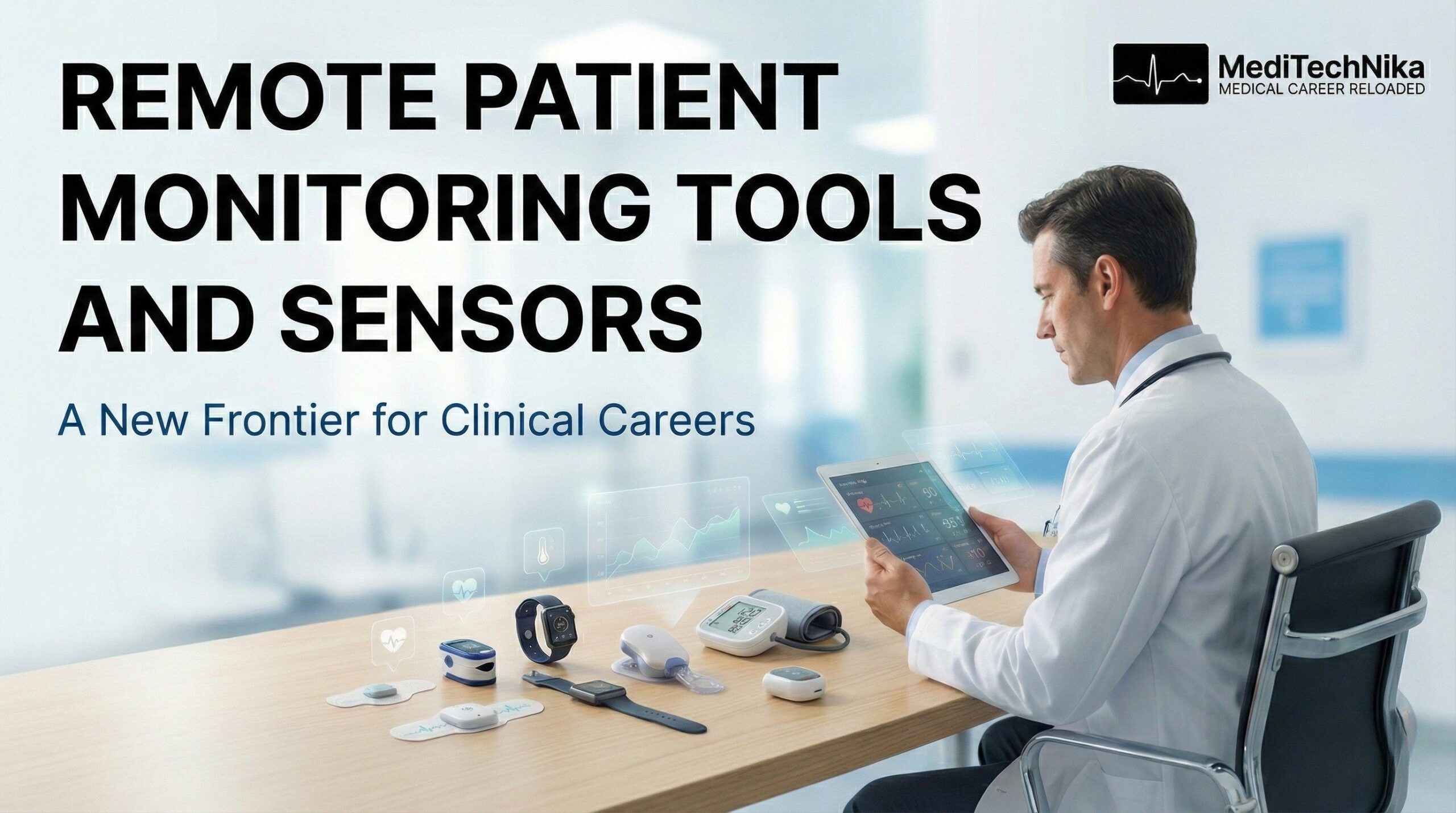
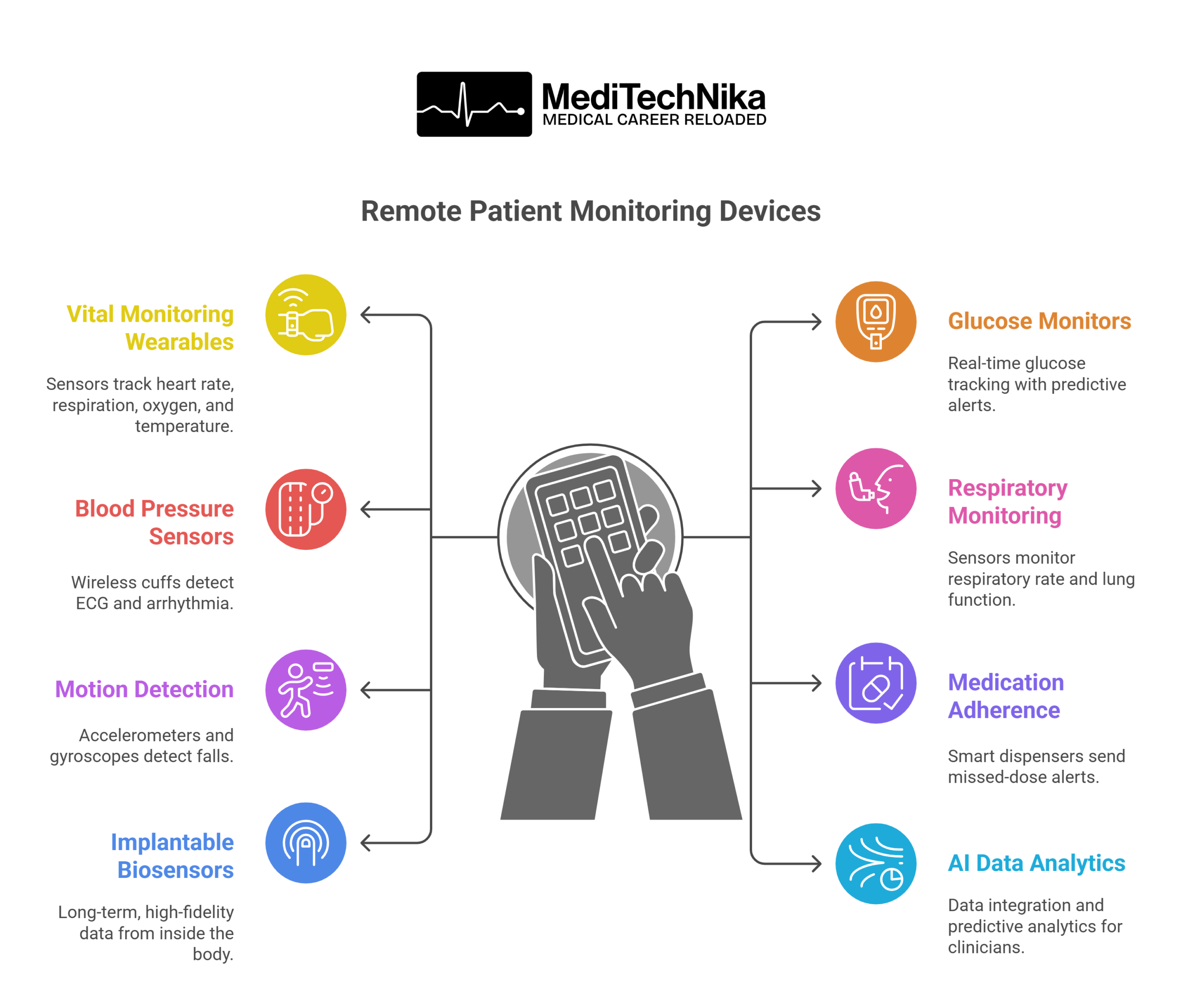
The remote patient monitoring systems are wearable medical devices that are highly dependent on biosensor technology. When these wearable biosensors are integrated with the AI-driven analytical platforms, they can transform the raw data into actionable clinical information. Some of the most important and impactful tools include:
-
Continuous Vital Monitoring Wearables:
These are the wearable medical devices that are worn on the body; they are wireless, flexible, skin-friendly, and have the capacity to track physiological data like heart rate & rhythms, respiratory changes, oxygen levels, and body temperature.
These sensors help to detect the physiological changes, and they can send notifications to healthcare professionals. These advanced monitoring systems help clinicians with timely alerts and trends for better care.
-
Continuous Glucose Monitors (CGMs):
Glucose monitors are another type of wearable medical device/biosensor that are used to track glucose levels in real-time throughout the day and night. This offers a pattern analysis and gives insights into the personalized recommendations with predictive alerts.
These devices have a sensor, a transmitter, and a receiver. They provide smooth wireless communication and provide real-time monitoring. As there is an increase in diabetes cases, the continuous glucose monitoring system plays an important role in assessing the health risks for safer diabetes management.
-
Smart Blood Pressure and Cardiac Sensors
These are the biosensors that are used to detect and measure the blood pressure and cardiac rhythms (ECG signals). These are the wireless sensors that can be connected to smartphones and watches to track real-time data for detecting hypertension, hypotension, and abnormal heart rates. This reduces frequent visits to the hospital.
-
Respiratory and Pulmonary Monitoring Tools:
Respiratory and pulmonary monitoring sensors are used to track respiratory pattern changes, proper lung functioning, and coughing behaviour. It also helps to track real-time monitoring in patients with chronic lung infections or diseases
-
Motion, Gait, and Fall Detection Sensors:
These sensors are used to monitor the walking patterns or a person’s movement. Motion sensors are commonly used to detect general movements and help in measuring velocity and acceleration.
Gait sensors are used to analyse a person’s walking patterns and the abnormal gait movements to assess risk and stability. Fall detection sensors are a combination of motion sensors that are used to detect falls.
-
Smart Medication Adherence Devices:
These are another type of wearable medical device or biosensors that are commonly used for supporting people in taking medications properly. These sensors are automated; they give alerts and notifications to ensure that any dose of medicine is taken at the proper time. These devices are specifically designed for older adults who are facing difficulty in self-managing their own medications.
-
Implantable and Advanced Biosensors:
Implantable sensors are the type of sensors that are incorporated into the body to monitor real-time changes. These devices are placed in direct contact with the tissues where the data is transmitted with high fidelity.
-
AI-Driven Healthcare Data Analytics Platforms:
Data will be effective when it is interpreted properly without errors. These remote patient monitoring tools are now integrated into AI-based healthcare data analytics to detect large amounts of data, identify abnormalities, and support clinicians’ healthcare systems to focus more on actionable insights.
How RPM is Redefining Clinical Careers:
- Remote patient monitoring for clinical careers is not just a digital health technology; it is more than that for clinicians—it is a career revolution. This creates new opportunities for the clinicians who want to explore the field of biosensor technology and remote monitoring.
- A few emerging roles in digital health technology and remote patient monitoring are clinical data navigators, RPM program managers, digital therapeutic specialists, and patient engagement experts.
- Clinicians as data-driven decision makers: This helps clinicians to detect early complications in chronic disease patients, reducing hospital visits and readmissions, and improving personalized care.
- Expanding scope for allied health professionals: This not only impacts doctors, clinicians, but it also creates a huge impact on allied health professionals and paramedics. This expands the scope of autonomy and career mobility.
- Global opportunities for professionals: Remote patient monitoring has a huge impact on clinical careers and is in demand globally. As this is a growing field, professionals from different countries will have an opportunity to work and partner with international medtech companies and develop and implement strategies for virtual care.
The Future of RPM: Connected, Predictive, and Personalised:
The next generation of remote patient monitoring will include AI-based predictive healthcare data analytics, smart home monitoring systems, and multi-functional wearable biosensors to help clinical experts make work easy and manage patients across the globe.
Remote patient monitoring tools and sensors are reshaping both healthcare systems and careers for professionals, allowing constant monitoring and improved personalized care. Mastering RPM systems and biosensor technology is not just a skill but it creates novel roles, career growth, and leadership in the next generation of healthcare.