

Key Roles and Skills Doctors Need in AI-Driven Digital Healthcare
AI in Healthcare: Healthcare is a fast-growing sector, and doctors today are entering into roles that did not even exist a decade ago. The medical field is expanding beyond the hospital walls with the help of artificial intelligence, remote patient monitoring, and smart data models. This shift is not about replacing the doctors, but it is about enhancing them with the correct tools to reduce the burden and to improve decision-making for impactful career paths.
If you are a clinician wondering how to get into the digital era, this article breaks down the most meaningful careers for doctors in AI-powered care and health informatics.
What Is Virtual Care, and Why Is It Growing So Fast?
Before we get into the career paths, let us first know what virtual care is. In simple terms, virtual care is a health service that is provided virtually. For example, through video calls, using digital triage systems, or using biosensor technology, especially the wearables, to monitor the patient.
This includes remote monitoring, and telemedicine is also a part of virtual care, mainly focusing on clinical consultations. Virtual care is very important because of the growing demand, to increase assistance for the rural populations, to reduce multiple visits to the hospital, and to allow both clinicians and patients to give and receive services at their convenience. The main focus is to enable continuous monitoring for chronic disease management.
The Role of AI in Healthcare: A Driving Force Behind New Careers
When we talk about new career opportunities, AI in healthcare plays a major role in creating these opportunities. Amongst all the digital technologies, AI in healthcare is the biggest facilitator for the job transformation. AI tools now support doctors in interpreting the diagnostic information, early screening, and automation in the workflow.
A few examples to include are AI-assisted radiology tools; artificial intelligence is now booming in the field of radiology for accuracy and mitigating human errors. These advancements are not replacing the clinicians but helping them to improve patient care and providing opportunities for doctors who are passionate about exploring medicine with technology. Here are a few roles that are driving the healthcare system.
-
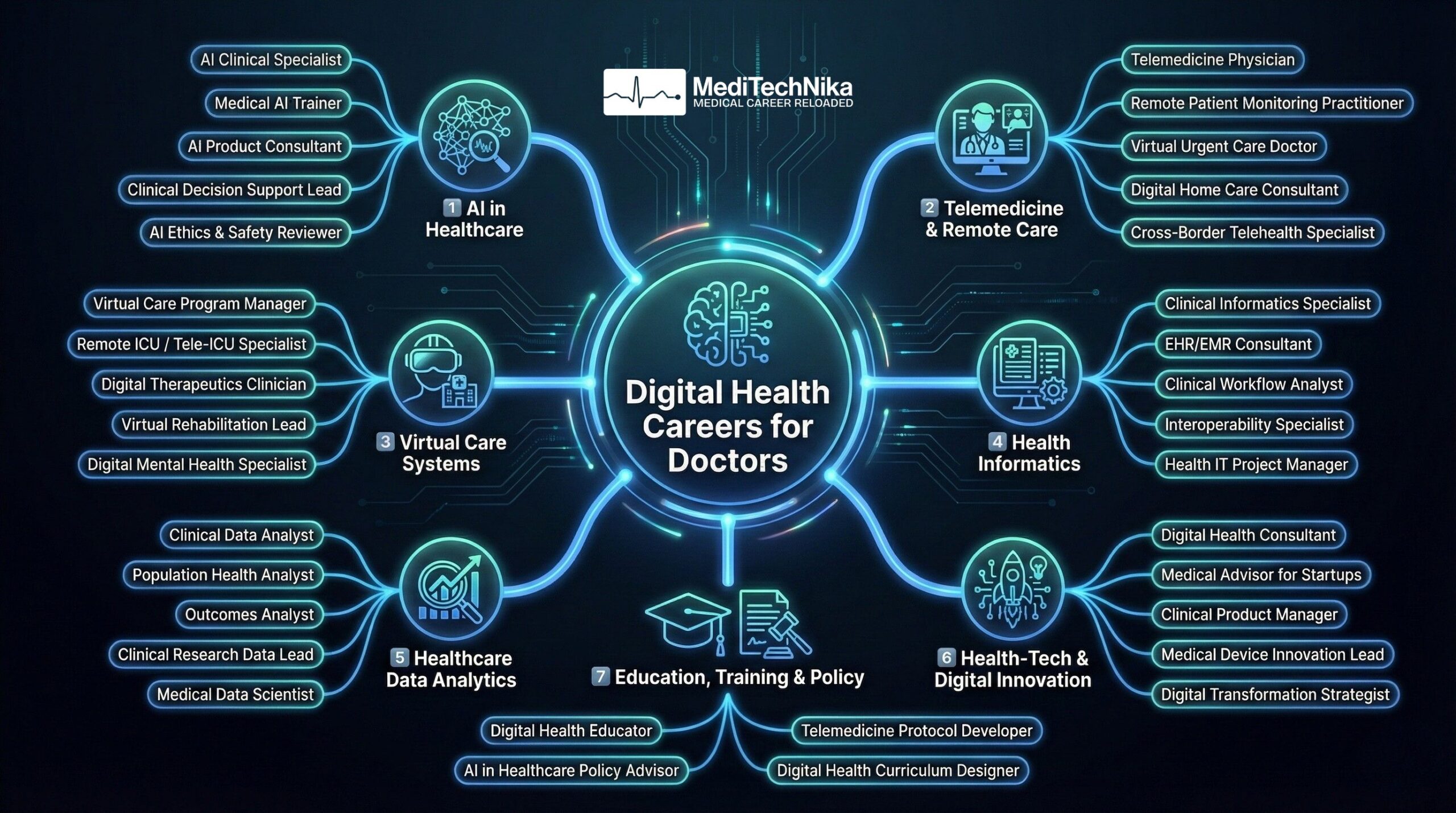
Telemedicine Physician or Remote Care Consultant
Telemedicine is one of the rapidly growing career paths in the healthcare sector. This helps doctors to provide consultations from anywhere at any time. After the pandemic, hospitals have integrated virtual care platforms at a massive scale. Along with the hospital, a few start-ups, digital clinics, and insurance providers also started following and using these platforms for better patient communication and care.
Doctors who choose this as their career option will enjoy the flexible work hours, less burden and will have an opportunity to specialize in chronic care, dermatology, and mental health.
-
Healthcare Informatics Specialist: Bridging Clinical Care And Digital Systems
Health informatics is a highly demanding digital health domain. For doctors who are interested in shifting their careers to digital platforms, this path will be ideal. A clinician in health informatics will be dealing with AI-based tools that can be incorporated into the hospital systems, designing and improving EHRs, creating documentation workflows, and ensuring data privacy and security.
-
Healthcare Data Analytics for Clinical Insights and Population Health
Healthcare data analytics is another major career path for doctors. With the increase in the generation of data daily worldwide, doctors also need to be trained on how to interpret the data in a fast and efficient way. The role majorly focuses on population health, quality improvement, and research data strategies. Doctors who can master these skills can identify the care gaps and reduce re-admissions, and improve patient outcomes.
-
AI-Enabled Virtual Care Specialist
This emerging career combines both telemedicine and AI systems. This involves how AI tools interact with the patients and clinicians to ensure accuracy and safety with ethical use. This field is especially for doctors who enjoy technology, as well as those who want to work closely with developers and product teams.
-
Digital Health Consultant or Health-Tech Advisor
Digital start-ups, medical device innovators, and health-tech companies are now in need of doctors who can guide product design and clinical validation. A digital health consultant often involves reviewing AI models and algorithms, ensuring clinical accuracy, and also helping to design user-friendly platforms for clinicians and patients.
Skills Needed To Transition into Digital Health Careers
Doctors already have a strong foundation, but these additional skills will help them enter the digital health era.
- Understanding the workflow
- Learning digital tools
- Healthcare data analytics
- Knowledge about ethical frameworks
Why Digital Health Careers Matter for Doctors
Digital health is not just a new trend, but it is a fundamental shift in how healthcare will be delivered next decade. Doctors who enter into this space can improve patient outcomes, reduce burden with the use of smart tools, and one more advantage is location-independent careers. Mainly, digital health helps doctors focus more on patient care than on the technology. Digital health careers for doctors are no longer limited to hospital-based tools.
With the rise of AI in healthcare, virtual care, and health informatics, doctors have many paths to grow and make a meaningful impact. The future of medicine is a mixture of clinical expertise with technology. Doctors who embrace this transformation will lead the next generation of healthcare.