

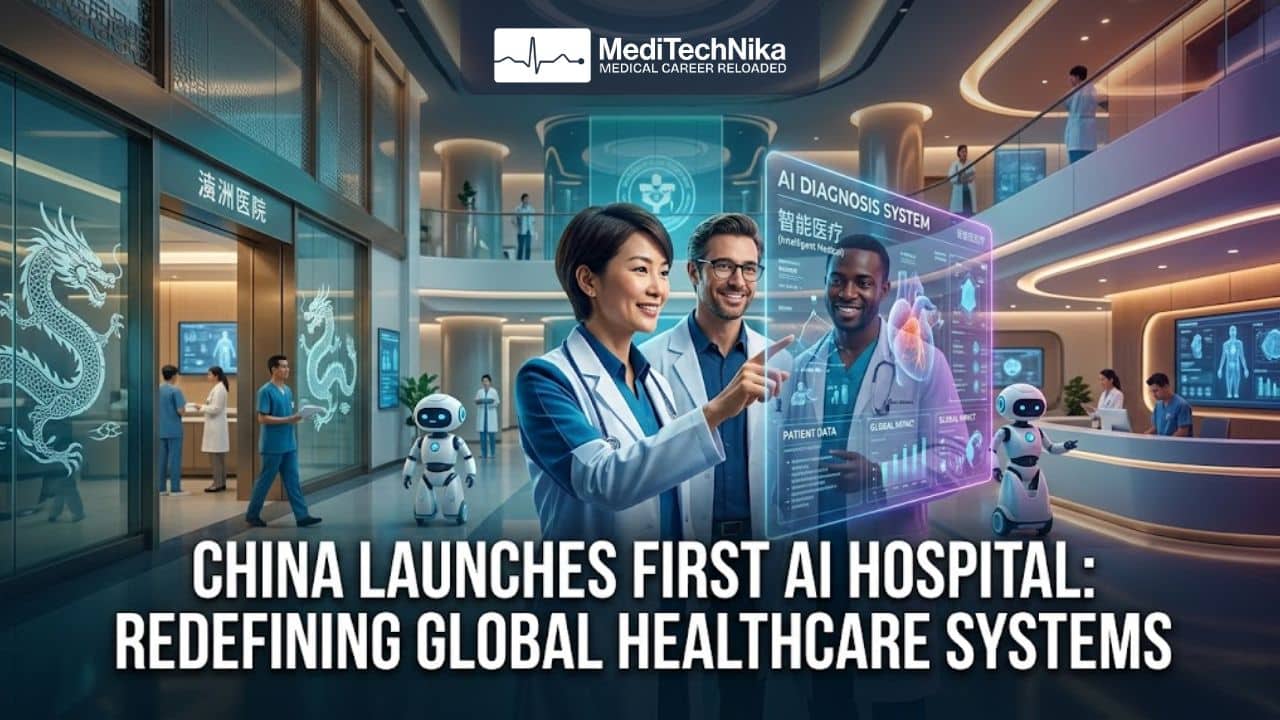
China’s First AI Hospital
Imagine that you could get medical advice before you even reach a hospital. You upload your symptoms on your phone, and by the time you meet a doctor, your case is already prepared. After the treatment is complete, the system continues to provide reminders, medication alerts, and more. This is no longer a concept. This is becoming a reality with China’s First AI Hospital. This is leading to a Global Healthcare transformation.
China officially launched its first AI Hospital in Boao, located in Hainan Province, in March 2026. The project, officially known as the Hainan Boao Super Digital Intelligence Hospital, is situated within the Boao Lecheng International Medical Tourism Pilot Zone, a unique healthcare hub approved by the State Council in 2013. This marks a significant milestone for China with the opening of its First AI Hospital. It is a place where technology is supporting doctors to reshape patient care.
Early diagnosis, treatment, and follow-up care are the different stages of healthcare that are connected using Artificial Intelligence in this Hospital. Patients can upload their medical records online, receive risk alerts, and even receive medication reminders after treatment. This makes a continuous care system rather than isolated hospital visits. This is strengthening the idea of the Global Healthcare System in China’s AI Hospital
At the Zhongguancun Forum 2026, the concept of an AI Hospital was discussed. Experts defined that is a system that combines offline medical expertise with online digital tools. This means that patients no longer need to depend on in-person visits to hospitals. Healthcare becomes more accessible and connected, in line with the vision of China’s First AI Hospital.
At the core of this hospital lies a sophisticated AI-driven infrastructure. The system includes an intelligent network platform supported by a MaaS (Mobility-as-a-Service) results promotion model, designed to bridge the gap between research, clinical application, and patient access. Embedded within this system are advanced modules such as “thousand-disease agents” and “thousand-hospital agents,” along with AI assistants for specially licensed drugs and medical devices.
One of the most interesting features of this Hospital is how AI helps patients to find the right treatment. Patients had to search for advanced medicines and travel to places to get proper treatment. Now, the system can identify patients who need specific treatments and connect them directly. This highlights the efficiency of China’s First AI Hospital, which changes the traditional approach of treatment.
The hospital operates on a three-step system: local consultation, treatment at the AI hospital, and follow-up care at home. This reduces travel time and makes healthcare more convenient, especially for patients in remote areas. It shows how China’s First AI Hospital can improve access to quality medical services.
The Boao Lecheng pilot zone plays a critical role in enabling this system. Today, it hosts more than 30 medical institutions, including top-tier hospitals from across China and international healthcare providers. The zone has introduced over 500 innovative medicines and medical devices approved overseas but not yet available domestically, benefiting more than 200,000 patients. This ecosystem strengthens the operational backbone of China’s First AI Hospital.
China’s government is also supporting this transformation. In 2025, the National Health Commission of China introduced guidelines to regulate AI in healthcare. These policies aim to ensure that AI is used safely while improving services across prevention, diagnosis, and rehabilitation. This structured approach strengthens the foundation of China’s First AI Hospital.
The scale of AI adoption in China’s healthcare system is already substantial. As of May 2025, approximately 300 large medical AI models had been developed nationwide. Meanwhile, remote medical imaging services at the county level have processed more than 68 million cases, demonstrating how AI is supporting primary healthcare delivery. These advancements provide a strong foundation for expanding China’s First AI Hospital.
However, the rapid growth of AI in healthcare also raises important questions. Experts warn that too much information from AI reports may confuse or worry patients. There are also concerns about data privacy, accountability, and ethical use of technology. These challenges need careful attention as China’s First AI Hospital continues to develop.
Despite these concerns, the benefits are clear. AI hospitals can reduce waiting times, lower costs, and make healthcare more efficient. More importantly, they can bring advanced medical services to people who previously had limited access. This supports the broader goal of building a fair and inclusive healthcare system through China’s First AI Hospital.
Historically, major medical innovations from vaccines to antibiotics have improved global health and made care accessible to more people. AI could be the next step in this journey. As China takes the lead, the world will be watching closely to see how China’s First AI Hospital shapes the future of medicine.


