


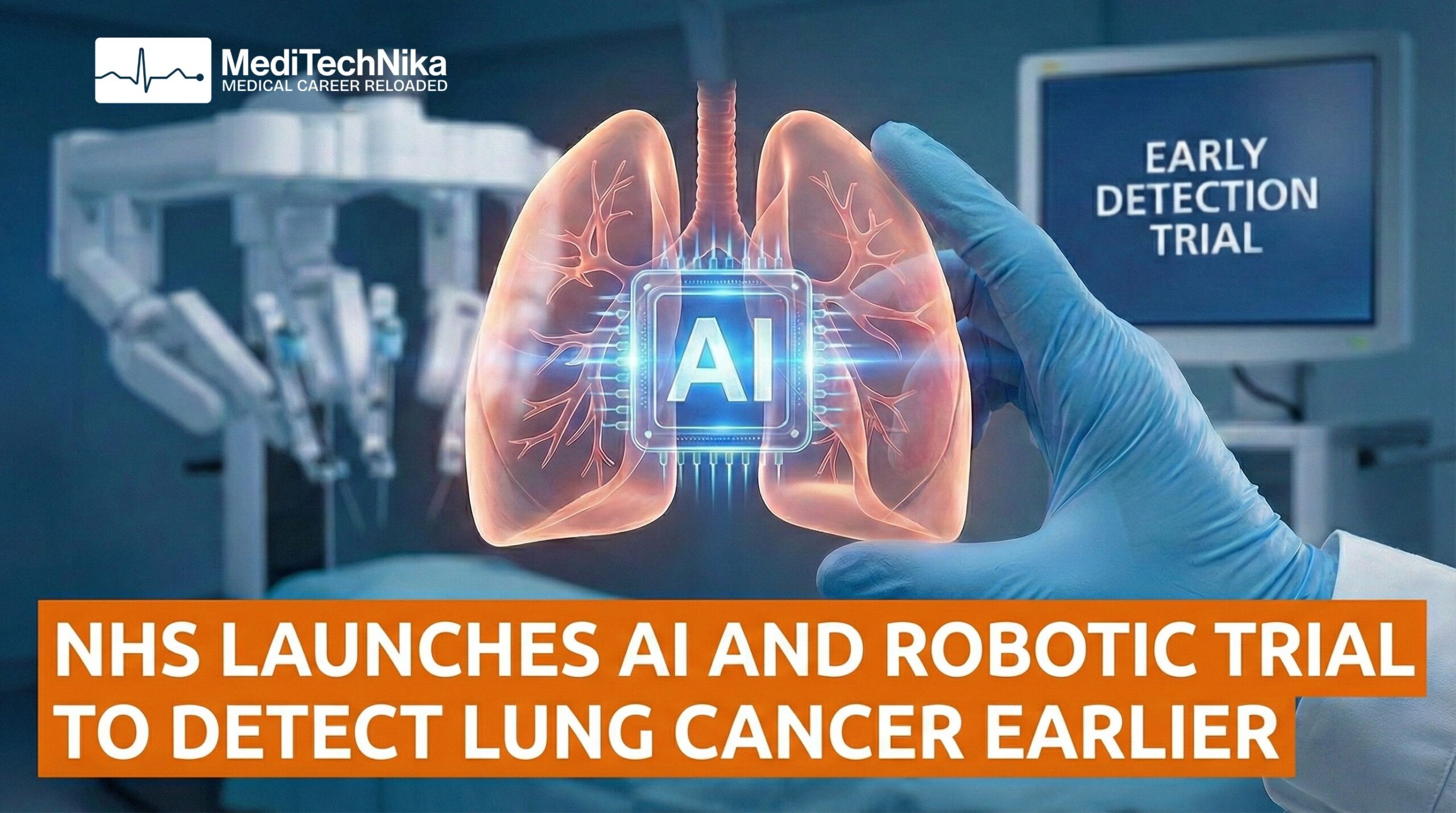
NHS Launches AI and Robotic Trial to Detect Lung Cancer Earlier
The NHS has launched a new pilot combining AI and robot-assisted care to identify and diagnose lung cancer sooner. A trial is about to be done for the same. It is supposed to speed up the detection and diagnosis of lung cancer. It is the UK’s most lethal form of cancer.
NHS England’s national clinical director for cancer, Professor Peter Johnson, said innovation will ‘help diagnose more cancers faster, so treatment can be most effective’.
The health service pledges to offer all smokers and ex-smokers the chance to be screened for lung cancer by 2030. The trial comes at the same time.
The expansion is expected to lead to an estimation of 50,000 lung cancers being diagnosed by 2035, of which 23,000 will be at an early stage, which could save thousands of lives, it said.
Lung cancer claims 33,100 lives a year across the UK, about 91 a day, and is a particular focus of the government’s forthcoming national cancer plan for England, as it is Britain’s biggest cancer killer, reflecting historic high rates of smoking.
It is also a key area for improvement because it is an example of health inequalities in the country, mirroring people’s wealth. And it affects poorer people excessively. It accounts for an entire year of the nine-year gap in life expectancy.
The trial will be carried out at Guy’s and St Thomas’ NHS trust in London. The chiefs of the NHS hope that establishing AI and robotic technology will help doctors uncover more cases. This will enable treatment to start sooner and increase the chance of survival.
“This is a glimpse of the future of cancer detection”, said Prof Peter Johnson, NHS England’s national clinical director for cancer.
Lung scans will be analyzed by AI software, which will alert doctors to the presence of small lumps. The small lumps can be just 6mm long (the size of a grain of rice) and are most likely cancerous.
There will be a robotic camera, which will then guide the miniature tools used to perform a biopsy, to produce a tissue sample to be analyzed in a laboratory with existing techniques. This will enable potentially cancerous nodules hidden deep in the lung, which are hard to spot at present.
“If shown to be effective, the technology could help transform lung cancer diagnosis as the NHS screening programme increasingly identifies more people with very small nodules that would previously have gone undetected until much later”, NHS England said.
It said, “For many patients, weeks of repeat scans and procedures could be replaced with a single half-hour cancer biopsy, reducing prolonged uncertainty and avoiding more invasive surgery”.
The team behind the trial has already carried out about 300 robotic biopsies, which led to 215 people having cancer treatment.
Michelle Mitchell, the chief executive of Cancer Research UK, said that “Lung cancer is the leading cause of cancer death in the UK, but diagnosing it at an earlier stage can significantly improve people’s chances of survival”.
“New technologies like this have huge potential, and tests to ensure they’re accurate and beneficial for patients in the real world should happen quickly so that innovations can reach everyone sooner,” he added.