


Medical Communications Career for Doctors: Medical Writing, MSL, Skills, Salary & Global Opportunities
Are you a doctor who enjoys explaining medical concepts, reading scientific literature or turning complex clinical information into something easier to understand? If you are considering a career different from traditional clinical practice, medical communications can be an interesting career option to explore.
Medical communications, often called medcomms, combine medical knowledge, scientific evidence, writing and communication. It involves creating accurate, audience-appropriate content from clinical research, medical literature, treatment information and scientific data.
For doctors, this can open opportunities in medical writing, medical editing, medical information, Medical Affairs, Medical Science Liaison (MSL) roles and scientific communications.
This guide explores the major career paths, skills required, salary considerations, global opportunities and practical steps doctors can take to enter medical communications.
What is Medical Communications?
Medical Communications are translating complex scientific and clinical proof into accurate, clear and audience-friendly language.
The audience is not always the general public. Depending on the role, medical communications professionals may create content for:
- Healthcare professionals
- Researchers and scientists
- Regulatory authorities
- Patients and caregivers
- Internal medical teams
- Commercial teams
- Pharmaceutical and biotechnology companies
- Healthcare organisations
Examples of medical communications content include:
- Articles for doctors and healthcare professionals
- Training material for sales and marketing teams
- Patient education booklets
- Presentations for medical conferences
- Content for regulatory submissions
- Public health awareness campaigns
The plan is accuracy first, clarity second. Medical Information needs to be scientifically correct while also being easy to understand for the audience.
Why Do Doctors Have an Advantage in Medical Communications?
Simple.They understand the human body better than any other person.
For example, a doctor may already have experience with:
- Case presentations
- Journal clubs
- Clinical discussions
- Literature review
- Patient education
- Explaining complex medical concepts
- Interpreting clinical findings
These experiences can provide a useful foundation for medical communications.
A good medical communications professional also needs to develop their skills in Scientific Writing, Literature Searching, referencing, editing, and data interpretation for a wide range of audiences. In short, Doctors have the advantage of clinical knowledge, but they still need to build communication and industry-specific skills.
Medical Communications Career Paths for Doctors :
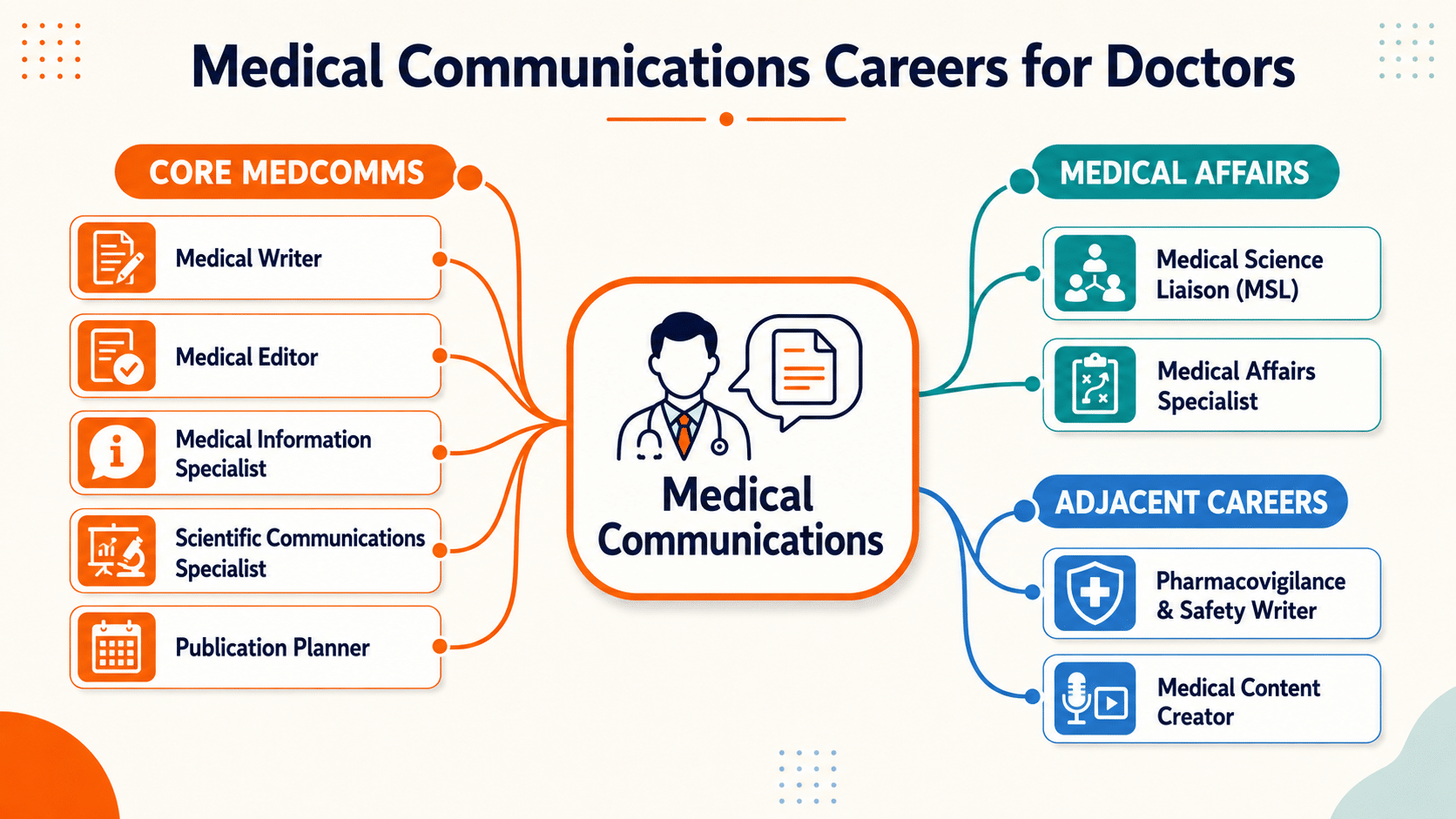

Medical communications is wider than medical writing alone. Some careers sit directly within medical communications, while others bridge between Medical Affairs, pharmacovigilance or health communication.
A useful way to understand the field is to divide it into three groups:
Core Medical Communication Jobs:
1. Medical Writer
Medical writing is one of the most established career paths within medical communications.
A medical writer develops scientifically accurate documents and content for different audiences. The type of work depends heavily on the organisation and the writer’s specialisation.
Medical writing can broadly be divided into several tracks:
Regulatory Medical Writer
Regulatory medical writers prepare documents used during the drug-development and regulatory-submission process.
Their work may involve:
- Clinical study documentation
- Regulatory submission documents
- Clinical summaries
- Safety-related documents
- Documents supporting interactions with regulatory authorities
Regulatory writing requires strong attention to detail and familiarity with regulatory requirements and clinical-development processes.
Publication Medical Writer
Publication writers work on scientific and medical publications and related congress materials.
Their work may include:
- Manuscripts
- Abstracts
- Posters
- Congress presentations
- Literature reviews
- Plain-language summaries
- Publication-support materials
Publication writing also requires awareness of publication ethics, reporting guidelines and appropriate citation practices.
Educational and Scientific Writer
Educational writers develop scientifically accurate materials designed to communicate medical information to healthcare professionals, patients or other audiences.
Examples include:
- Disease-awareness content
- Medical education materials
- Healthcare professional resources
- Training materials
- Scientific articles
Educational and promotional writing should not be treated as identical. Promotional content operates within specific regulatory and compliance requirements, while independent scientific or educational content has different objectives and standards.
2. Medical Editor
Medical editors review content produced by medical writers and other professionals.
Their responsibilities can include checking:
- Scientific accuracy
- Grammar and language
- Consistency
- References and citations
- Formatting
- Logical flow
- Style requirements
- Applicable publication or regulatory standards
This role can suit doctors who enjoy writing but are more interested in reviewing, refining and improving scientific content.
Attention to detail is essential because even small errors can affect the clarity or accuracy of medical information.
3. Medical Information Specialist
Medical Information professionals respond to scientific and medical questions from healthcare professionals, patients or other stakeholders, depending on the organisation.
The work may involve:
- Reviewing scientific literature
- Evaluating product information
- Preparing accurate responses to medical queries
- Maintaining medical information documents
- Working with cross-functional medical teams
This career can be relevant for doctors who enjoy researching questions and communicating evidence clearly.
4. Scientific/Medical Communications Specialist
Scientific or medical communications specialists may work on a wide range of scientific communication activities.
Depending on the organisation, their work can include:
- Scientific content development
- Medical education
- Conference-related materials
- Scientific presentations
- Evidence communication
- Internal medical communications
- Stakeholder communication
The exact responsibilities vary considerably between pharmaceutical companies, biotechnology companies, CROs and medical communications agencies.
5. Publication Planner or Publication Manager
Publication planning focuses on strategically planning and managing scientific publications around research and clinical data.
Professionals in this area may contribute to:
- Publication plans
- Manuscript development
- Congress strategies
- Author and stakeholder coordination
- Publication timelines
- Review processes
This can be a good fit for doctors who enjoy both scientific content and project coordination.
Related Medical Affairs Careers
Not every career involving scientific communication belongs to core medical communications. Medical Affairs is a broader function within the pharmaceutical and healthcare industry.
6. Medical Science Liaison (MSL)
An MSL is primarily involved in non-promotional scientific exchange with healthcare professionals and scientific stakeholders.
Depending on the organisation, MSL responsibilities may include:
- Communicating scientific and clinical evidence
- Engaging with healthcare professionals and researchers
- Supporting appropriate evidence-generation activities
- Gathering actionable insights from the field
- Supporting scientific discussions around products or therapeutic areas
MSL roles can suit doctors who enjoy interaction, scientific discussion and relationship-building more than purely desk-based writing.
Unlike a medical writer, an MSL typically spends much more time communicating directly with external scientific stakeholders.
7. Medical Affairs Specialist
Medical Affairs is a broader career area that supports scientific and medical activities across the product lifecycle.
Depending on the role, Medical Affairs professionals may contribute to:
- Medical strategy
- Evidence generation
- Medical education
- Scientific exchange
- Internal medical training
- External scientific activities
- Cross-functional medical projects
Medical Affairs should not simply be described as a bridge between research and marketing. It is a distinct scientific and medical function that operates within appropriate non-promotional boundaries.
Adjacent Medical Careers
8. Pharmacovigilance and Safety Writer
Pharmacovigilance focuses primarily on monitoring and evaluating the safety of medicines.
A safety writer may contribute to documentation involving:
- Drug safety information
- Safety reports
- Aggregate safety documentation
- Regulatory safety communications
This is best considered an adjacent career to medical communications because writing is part of the function, while the primary focus is drug safety.
Doctors interested in pharmacology, adverse events and medicine safety may find this career particularly relevant.
- Medical Content Creator
Health journalism and medical content creation are more public-facing careers.
Professionals may work on:
- Health articles
- Digital health content
- Medical news
- Podcasts
- Video content
- Social media
- Public health communication
The key requirement is that medical content must remain evidence-based and avoid introducing misleading or unsupported health claims.
This path may appeal to doctors who enjoy combining medical knowledge with storytelling and digital communication.
Skills You Need to Build to Work in Medical Communications:
Some of the skills that you need to build are:
- Scientific & Medical Writing: Communicate complex medical information clearly and accurately
- Literature Search: Find relevant evidence and evaluate its quality and limitations
- Clinical Trial: Understand study design, endpoints, results and implications
- Biostatistics: Know key concepts like confidence intervals, risk ratios, odds ratios, sensitivity and specificity
- Referencing & Publication: Use correct citations and follow publication/reporting standards
- Editing & Proofreading: Identify and correct scientific, grammatical and structural errors
- Regulatory & GCP Awareness: Understand regulatory documents and Good Clinical Practice basics
- Presentation & Visualisation of Data: Present scientific data clearly and effectively
- Project Management: Coordinate with teams, manage deadlines and review cycles
- Responsible Use of AI: Use AI for support only; always verify accuracy and follow confidentiality and privacy rules
Medical Communications Salary for Doctors:
Salaries have many variations. Here are some of the points given:
- Experience: Senior professionals generally have a higher salary than entry-level candidates.
- Specialisation: Regulatory writing, Medical Affairs, MSL and other specialised roles may have different salary structures.
- Company of Interest: Pharma companies, CROs, agencies and healthcare organisations may offer different packages.
- Location: Salaries can vary between cities and countries.
- Therapeutic expertise: Experience in specialised therapeutic areas can influence career progression and compensation.
- Role responsibilities: Managerial, strategic and client-facing responsibilities can affect compensation.
Global Opportunities in Medical Communications
Medical communications opportunities exist across pharmaceutical, biotechnology, CRO and healthcare markets worldwide.
India
India has an established pharmaceutical, CRO and medical communications ecosystem, with opportunities across cities such as Bengaluru, Hyderabad, Mumbai, Pune, Gurugram and Chennai.
UK and Europe
The UK and European markets have opportunities in medical writing, regulatory writing, publication planning, Medical Affairs and medical communications.
United States
The US has a large pharmaceutical, biotechnology and healthcare ecosystem with a range of opportunities across medical writing, affairs and scientific communications.
Remote and Global Work
Some roles offer remote or hybrid arrangements. But, remote employment does not automatically remove employment, immigration or other legal requirements when working across countries.
How Can a Doctor Enter Medical Communications?
Step 1: Choose a Career Track
Decide whether you are most interested in:
- Medical writing
- Medical editing
- Medical information
- MSL
- Medical Affairs
- Regulatory writing
- Publication writing
- Pharmacovigilance
- Health communication
Step 2: Build Writing and Research Skills
Practise writing about medical and scientific topics and learn how to search, evaluate and reference scientific literature.
Step 3: Create a Portfolio
Write/Type 2–3 samples, like:
- Scientific articles
- Literature reviews
- Patient education pieces
- Medical education content
- Clinical study summaries
Step 4: Learn Industry-Specific Skills
Depending on the job you have chosen, learn about regulatory writing, publication ethics, GCP, Medical Affairs, pharmacovigilance or medical information.
Step 5: Optimise Your CV and LinkedIn
Add the experiences to your job page and make it clear in your profile that you are a good fit for this position.
Step 6: Start Applying
Explore opportunities at:
- Pharmaceutical companies
- Biotechnology companies
- CROs
- Medical communications agencies
- Healthcare organisations
- Research organisations
Other titles like Scientific Writer, Medical Communications Specialist, Medical Information Specialist, Regulatory Medical Writer can also work.
Frequently Asked Questions
Can an MBBS doctor become a medical writer?
Yes. An MBBS background provides useful clinical and scientific knowledge, but doctors still need to develop professional writing, research, editing and communication skills.
Is medical writing only about writing articles?
No. It can include regulatory documents, clinical research documents, scientific publications, congress materials, educational content and other evidence-based communication.
Is an MSL a medical communications job?
Yes.
An MSL is better classified as a related Medical Affairs career. The role focuses heavily on non-promotional scientific exchange with healthcare and scientific stakeholders.
Do doctors need a special degree for medical communications?
There is no single degree that defines the entire profession. Professionals from medicine, pharmacy, life sciences, nursing, research and writing backgrounds may enter different areas of the field.
Can medical communications be a non-clinical career?
Yes. Many medical communications and Medical Affairs roles are non-clinical, although eligibility requirements vary by employer.
Can these jobs be remote?
Some positions offer remote or hybrid arrangements, depending on the employer and location.
Allow yourself the chance to explore more of what medical communications can offer you. If you do decide to change your career, start by understanding what the job is about and then build the skills needed for that role. Create a couple of good writing samples and explore more job opportunities.
For doctors who enjoy science, research, writing and communication, medical communications can offer a career path beyond traditional clinical practice.


