

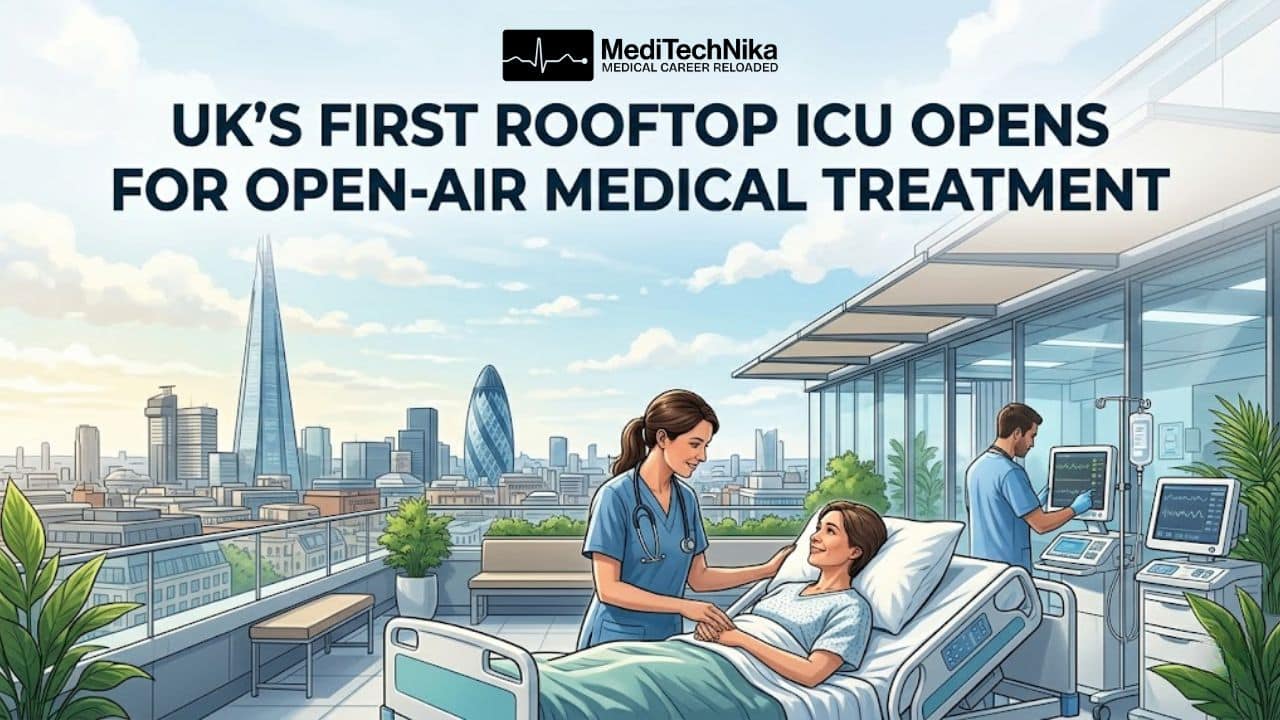
UK’s First Rooftop ICU
Do you know that for many hospitalized patients, the hardest part of recovery is not the disease itself? It is the feeling of being disconnected from the outside world. Many of them feel overwhelmed because of the days they spend under bright hospital lights, surrounded by machines and closed walls, and the smell of hospitals. Sometimes, a glance at the sky or a breath of fresh air can make a difficult day feel a little easier.
A hospital in the UK has introduced an innovative approach to emergency care after knowing this human need. This is attracting healthcare professionals worldwide.
Imagine that you will be lying under the open sky, breathe fresh air, and get intensive care from doctors. Is it unimaginable, right? But King’s College Hospital made that happen. They introduced the UK’s first rooftop ICU.
A Rooftop ICU Unlike Any Other
King’s College Hospital in London has opened the UK’s first rooftop intensive care ward. This is offering a specially designed outdoor space for critically ill patients. By bringing modern medicine and nature together, the initiative creates an environment where patients can safely spend time outdoors while receiving critical care.
The rooftop facility can accommodate up to six patients at a time, with access to oxygen, power supplies, medical gases, and monitoring equipment through specially designed weatherproof medical stations.
The concept behind this Open-Air Medical Treatment program is simple yet powerful. The project was funded through a £2 million donation from King’s College Hospital Charity, along with additional support from the hospital trust.
Patients recovering from serious illnesses spend a lot of time in intensive care units. They may get limited exposure to sunlight, fresh air, and natural surroundings during this time. But this rooftop facility changes that experience.
Why Fresh Air Matters in Critical Care?
For many ICU patients, recovery is not the only challenge. Long hospital stays can also affect them both emotionally and psychologically.
Patients may spend days inside the hospital rooms with little exposure to daylight, fresh air, or natural surroundings. Some experience anxiety, depression, confusion, and even hallucinations. These can affect both patient well-being and recovery.
Research has long suggested that access to natural environments may help reduce stress, improve mood, and support emotional recovery. While fresh air is not a replacement for medical treatment, it can become an important part of a patient’s healing journey. It may support emotional well-being alongside medical treatment.
A Garden Designed for Healing
The rooftop space is far more than a terrace with a few plants. This Rooftop ICU was designed by renowned landscape architect Nigel Dunnett and award-winning garden designer Sarah Price. They planned to provide a calming environment for the patients.
The garden has aromatic plants such as rosemary, sage, and oregano. It also has the native species and soft-textured plants like lamb’s ear. Patients can see greenery, feel different textures, smell natural scents, and reconnect with the outdoors.
Every element was chosen with recovery in mind.
The Open-Air Medical Treatment demonstrates how healthcare design can focus not only on treating illness but also on improving the overall patient experience.
Addressing a Hidden Challenge: ICU Delirium
Delirium is one of the biggest concerns in intensive care medicine.
ICU delirium is a common condition among critically ill patients. It can cause confusion, memory problems, and frightening hallucinations, often affecting recovery even after discharge.
Patients who spend a long time in critical care can become more confused about time, place, and reality. Some experience hallucinations that continue to affect them after leaving the hospital.
This outdoor intensive is believed to give patients access to daylight, fresh air, and natural surroundings. The outdoor ICU space may help reduce all the effects.
Even a short visit outdoors can provide reassurance for patients who have spent weeks connected to machines.
What would be the Benefits of this Rooftop ICU?
The hospital also plans to study the scientific impact of the Rooftop ICU.
Researchers aim to determine whether time spent outdoors can reduce hospital stays and improve long-term physical and mental health. They’ll check whether it lowers blood pressure and stress, may potentially improve recovery outcomes, and curbs delirium.
If the results are good, it could inspire other hospitals worldwide. Also, the UK’s First Rooftop ICU might set trends in the design of future healthcare spaces.
Future of Healthcare
King’s College Hospital’s Critical Care Center cares for over 5,000 patients yearly and around 15,000 family members. Sometimes, healing happens when people feel the sun on their skin, hear distant birds, or just glimpse the sky. After weeks inside, this can mean so much.
The Open-Air Medical Treatment demonstrates how hospitals can blend top medical care with nature’s healing powers. As healthcare evolves, this trailblazing project could guide a kinder, more people-focused future in critical care. So, it shows hospitals don’t have to be isolated from the world’s little natural escapes.
In an era where healthcare innovation is often associated with advanced technology, King’s College Hospital is proving that sometimes the most powerful medicine can be as simple as fresh air, sunlight, and a connection to nature.


