

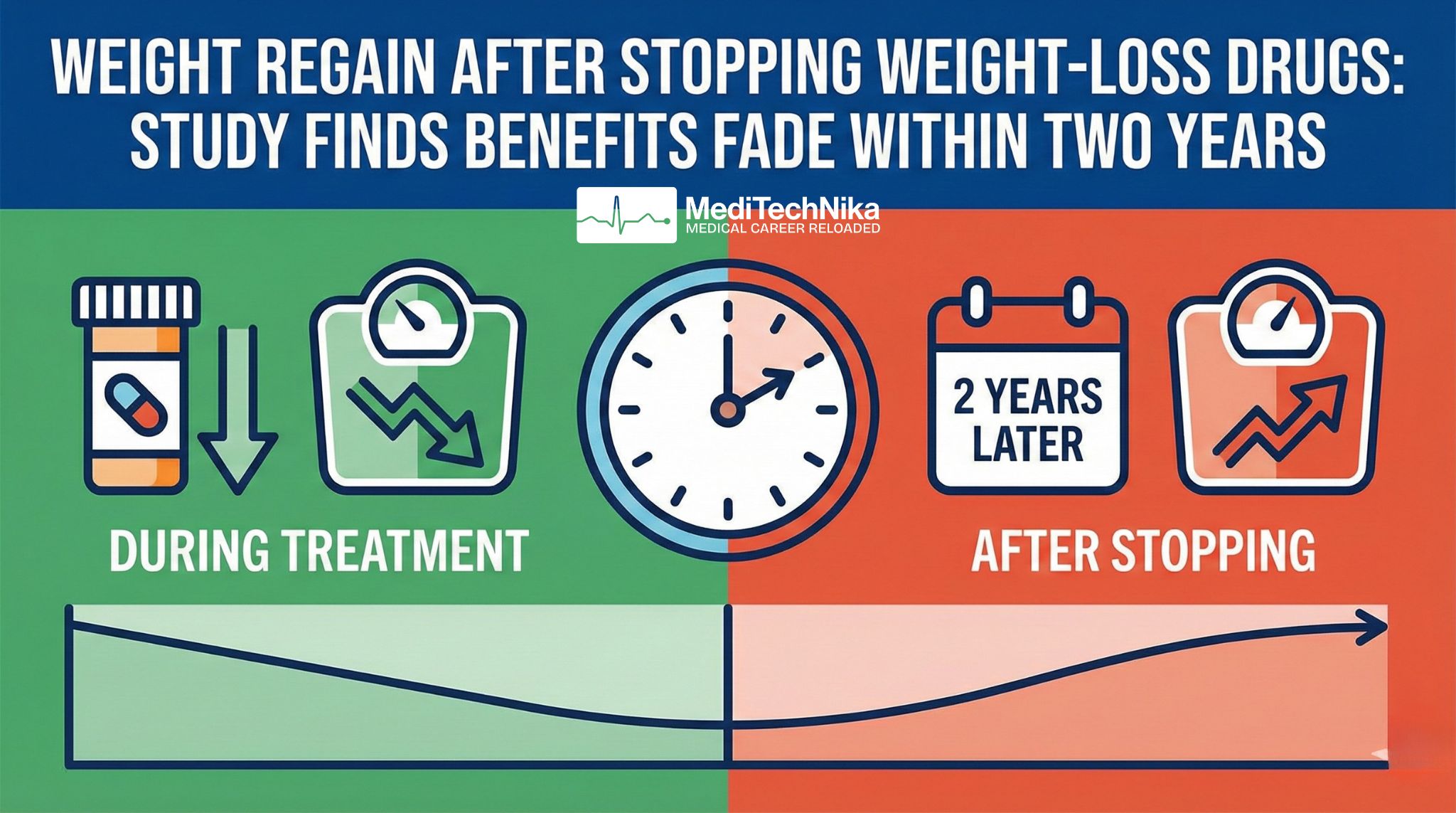
Weight Regain After Stopping Weight-Loss Drugs: Study Finds Benefits Fade Within Two Years
Did you know that when patients stop taking weight-loss medicine, the beneficial effects of the medicines on weight seem to disappear within two years? Yes, this is right, it was found by a large analysis of earlier research.
A study was conducted at the University of Oxford and published in the BMJ. It included a review of 37 existing studies regarding weight-loss medication, which involved about 9341 participants. The average duration of the weight-loss treatment was found to be 9 months, while the average follow-up period was 7-7.5 months.
Researchers have found that 9341 obese patients have regained nearly one pound (0.4 kg) per month after stopping the drugs. It was also found that they returned to pre-treatment weight by 1.7 years.
To be specific, patients on any kind of weight-loss medication lost about 8.3 kgs during treatment, but they regained an average of 4.8 kgs within the first year of not consuming the medicines.
According to studies in the BMJ, heart health risk factors, such as cholesterol levels and blood pressure, returned to pre-treatment levels within 1.4 years. Roughly 50% of the patients had consumed GLP-1 medications. This included the 1776 patients who received the newer and more effective drugs like semaglutide, which is sold by Ozempic, and Wegovy, which is sold by Novo Nordisk, and Tirzepatide (sold as Mounjaro and Zepbound by Eli Lilly).
When they looked into the weight regain rate, it was faster with semaglutide and tirzepatide, accounting for nearly 1.8 pounds (0.8 kgs) per month.
A senior researcher of Oxford University, Dimitrios Koutoukidis study stated that “But because people on semaglutide or tirzepatide lose more weight in the first place, they all end up returning to baseline at approximately the same time”. That meant roughly 1.5 years with these new drugs compared to 1.7 years after stopping any of the drugs.
Dr. Sam West at the University of Oxford said that the rapid weight gain seen after stopping the medications was not only due to the medicine itself. He also said, “These medicines are transforming obesity treatment and can achieve important weight loss. However, our research shows that people tend to regain weight rapidly after stopping – faster than we see with behavioural programmes”.
“This isn’t a failing of the medicines – it reflects the nature of obesity as a chronic, relapsing condition. It sounds a cautionary note for short-term use without a more comprehensive approach to long-term weight management, and highlights the importance of primary prevention,” He added.
An NHS spokesperson said: “While these new treatments are an important new tool for supporting weight loss, they’re not a magic fix and must be paired with behavioural and lifestyle wraparound support, including advice on healthier diets and physical activity to keep the weight off in the long term”.
Weight loss drugs work well while you take them, but they are not a permanent fix. A new study shows that once people stop taking the medicine, their weight and health problems (like high blood pressure) usually return to how they were within 1.5 years.
The NHS says these drugs are a great “window of opportunity,” but they must be used alongside a long-term plan to change daily habits.