


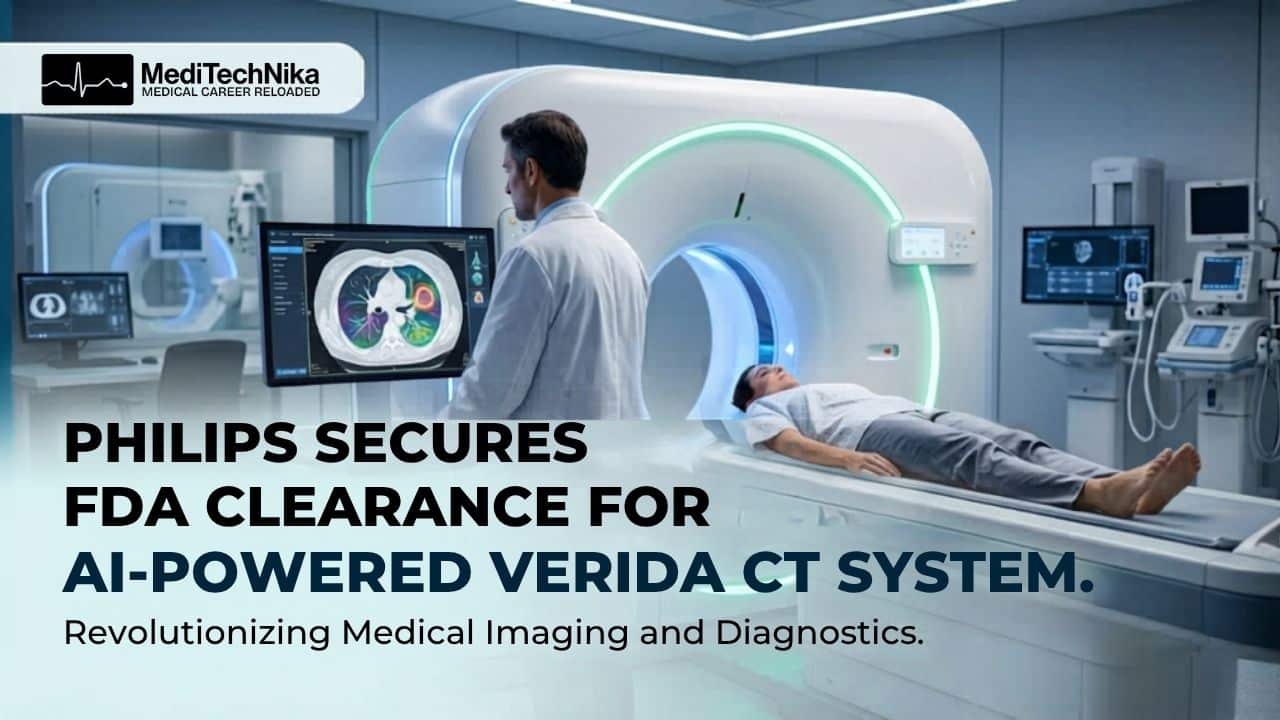
AI-Powered Verida CT System
Doctors wait a long time for a CT Scan to process while a large number of patients fill the hallway. This was the case a few years ago. Back then, there were many improvements in CT Imaging that focused on making scanners faster, sharper, and safer by reducing radiation doses. The focus began to change over time. It was not just about the machine anymore. It was about how smoothly the entire process could run. CT Imaging systems are becoming smarter with the help of Artificial Intelligence (AI). AI can guide workflows and reduce manual effort. An AI-Powered CT System presents clearer and more accurate images. They help doctors spend less time waiting and more time making decisions that matter.
Philips has received 510(k) clearance from the U.S. Food and Drug Administration (FDA) for its latest AI-powered CT imaging system, Verida. This could be a major step forward for modern diagnostic imaging. The approval highlights how artificial intelligence (AI) is steadily transforming the way doctors capture and interpret medical images.
The newly approved system combines artificial intelligence (AI) with spectral CT technology. This could improve speed, image quality, and patient throughput. Philips aims to strengthen its position in the competitive premium CT imaging system market over the next few years by addressing the growing demands of modern healthcare systems.
A Smarter Approach to CT Imaging
One of the most notable features of the Verida CT imaging system is its AI-driven reconstruction engine. According to Philips, the system achieves up to an 80% reduction in image noise, which significantly enhances clarity. Lower noise levels mean radiologists can detect subtle lesions, tissue variations, and early-stage abnormalities with greater confidence.
In addition to noise reduction, AI also contributes to dose optimization. The system intelligently processes imaging data to maintain diagnostic accuracy while potentially lowering radiation exposure, an ongoing priority in CT imaging system development.
The integration of AI into the CT imaging system also enables smarter workflow automation. From scan acquisition to reconstruction, the system minimizes manual intervention, helping radiology teams focus more on clinical interpretation rather than technical adjustments.
Improving Workflow in Hospitals
Speed is another defining advantage of the Verida platform. The system can reconstruct up to 145 images per second, effectively doubling its predecessor’s performance. This allows clinicians to review completed scans in less than 30 seconds, a critical factor in time-sensitive environments such as emergency departments.
In practical terms, this performance translates into significantly improved operational efficiency. Philips estimates that a facility operating the CT imaging system for 16 hours per day can perform up to 270 patient exams daily. This level of throughput is particularly valuable in high-volume hospitals where patient backlogs and long waiting times are common challenges.it
How AI-Powered CT Systems Stand Out in the Market?
The global market for advanced CT imaging systems is becoming increasingly competitive, with companies such as GE HealthCare and Siemens Healthineers focusing on photon-counting technology. While photon-counting CT is considered powerful, Philips believes its AI-enabled spectral CT approach is better suited for high-volume clinical environments.
One of the reasons is cost. The Verida system is priced between 1 million and 2 million euros, making it more accessible compared to photon-counting systems, which can cost nearly double. This pricing strategy could help Philips attract hospitals looking for a balance between performance and affordability.
Spectral CT Meets AI: A Hybrid Diagnostic Approach
The Verida system builds upon Philips’ established expertise in spectral CT imaging. Unlike conventional CT imaging systems, spectral CT analyzes how tissues absorb X-rays at different energy levels. This enables differentiation between materials that appear identical on standard scans, such as distinguishing iodine from calcium or identifying specific tissue compositions.
By layering AI onto spectral CT, Philips enhances both quantitative and qualitative analysis. The AI algorithms assist in highlighting clinically relevant features, improving lesion detectability, and simplifying complex datasets into actionable insights for radiologists.
This hybrid approach allows clinicians to move closer to what Philips describes as a “direct-to-diagnosis” workflow, where results are faster, clearer, and more clinically meaningful.
Positioning AI-Powered CT System Against Photon-Counting CT Technology
The premium CT imaging system segment is currently dominated by innovation, particularly with the emergence of photon-counting CT technology. Competitors such as GE HealthCare and Siemens Healthineers have introduced photon-counting systems, which offer high spatial resolution and improved spectral imaging capabilities.
However, Philips is taking a different approach. According to company leadership, while photon-counting CT is promising, it is not yet optimized for high-throughput clinical environments. The Verida system, powered by AI and spectral CT, is designed specifically to handle large patient volumes without compromising performance.
Cost also plays a decisive role. The Verida CT imaging system is priced between €1 million and €2 million, with a midpoint of approximately €1.5 million. In contrast, photon-counting systems can cost nearly twice as much, making them less accessible for many healthcare providers.
This combination of cost efficiency, speed, and AI-driven performance positions Philips competitively in the global CT imaging system market.
Clinical Impact and Real-World Deployment
Beyond technical specifications, the real-world impact of the Verida system lies in its ability to improve patient care. Faster scan times reduce patient discomfort and motion artifacts, while improved image quality supports more accurate diagnoses.
The system has already received a CE mark in Europe, and initial installations are underway, including a site in Madrid. With FDA clearance now secured, Philips is expected to expand deployment across the United States and other key markets.
Future Outlook: AI-Driven Imaging Ecosystems
The FDA clearance of the Verida CT imaging system reflects a broader shift toward AI-driven healthcare. As imaging volumes continue to rise globally, healthcare systems are increasingly relying on AI to manage workloads, enhance diagnostic precision, and optimize resources.
Philips has indicated that it will continue exploring emerging technologies, including spectral photon-counting CT, once they are ready for large-scale clinical use. For now, the company is focusing on refining its AI-powered CT imaging system to meet the immediate needs of radiology departments.
Conclusion
With FDA clearance for the Verida platform, Philips has reinforced its commitment to innovation in CT imaging systems. By integrating AI with spectral imaging, the company is offering a solution that balances speed, accuracy, and cost, which are the three critical factors in today’s healthcare environment.
As AI continues to evolve, its role in CT imaging systems will only expand, shaping the future of diagnostics and enabling clinicians to deliver faster, more precise patient care.