


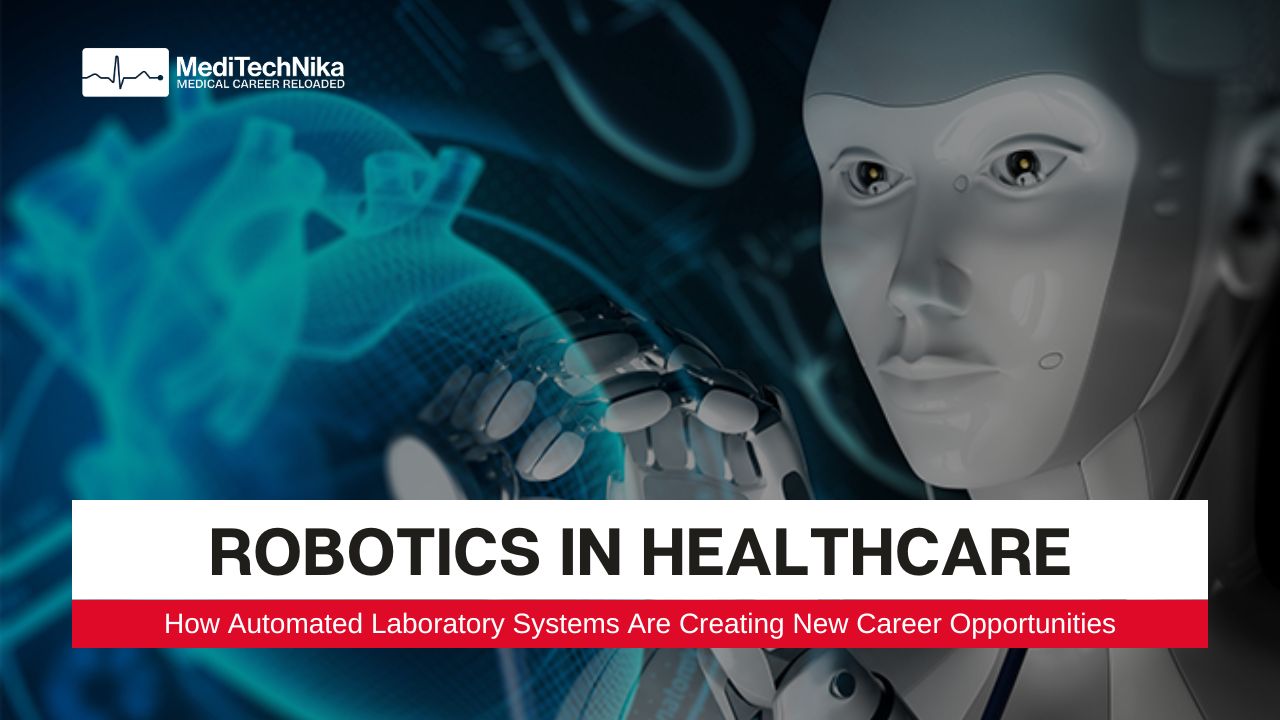
Robotics in Healthcare: How Automated Laboratory Systems Are Creating New Career Opportunities
Robotics in Healthcare: The rapid incorporation of robotics into the healthcare sector is now transforming how laboratories operate, how diagnostics are delivered, and how professionals prepare for the next decade of healthcare innovations.
With the adverse integration of robotics into healthcare, the medical/clinical laboratories have accelerated towards automation. New healthcare opportunities are emerging with the integration of robotic engineering, automation, and medical laboratory and healthcare technology.
Why Robotics in Healthcare Is Expanding So Rapidly:
As there is a shortage in skilled laboratory personnel, a demand for high accuracy and precision, and an increase in test volumes, robotics in healthcare is offering a solution by addressing three major challenges:
- Efficiency at Scale:
Thousands of samples within one hour can be processed with the help of automated robots with minimal human intervention. These advanced automatic robotic platforms help in oncology screening and tracking infectious diseases.
- Precision and Reliability:
Robotics helps in the reduction of human errors for laboratory tasks such as pipetting, aliquoting, and plate handling. This helps in the reliability, supporting precision diagnostics and accuracy, which is required in a medical laboratory environment.
- Workforce Optimization:
Optimization is another reason why we need robotics in healthcare. With laboratories struggling to identify trained staff, workforce optimization or automation helps to interpret the results, quality assurance, and troubleshooting.
By combining all these factors, we can identify why clinical laboratory automation has shifted from an optional enhancement to a strategic requirement.
Inside Modern Automated Laboratory Systems:
Today’s automated laboratory systems are interconnected with advanced sensors, software intelligence, and robotics. These technologies function as integrated ecosystems for better efficiency.
- Robotic Sample Handling:
These robotic systems ensure sample accuracy and traceability and reduce cross-contamination risks. Modern labs highly rely on robotic arms and conveyor belt systems for tube decapping, barcode identification, automated loading onto analyzers, and tube recapping.
- Pre-Analytical and Post-Analytical Automation:
Before the sample reaches the analyzers, there is a chance of contamination or a high chance of errors occurring. So, now this automation helps in solving these problems. Automation now handles:
- Centrifugation
- Slide staining
- Preparing reagents
- Decanting of liquids
So automation systems help in both pre-analytical and post-analytical automations.
- Integrated Analyzers with Robotic Connectivity:
Analyzers can now be connected with robotic tracks. There are different types of analyzers, like molecular diagnostics, immunology, hematology, biochemistry, and microbiology analyzers that can be networked with robotic tracks. This helps in transferring the samples without any disturbances from the collection point to the final point, with reporting.
- Smart Laboratory Software:
Smart laboratory software is now transforming the healthcare industry. Laboratory Information Systems (LIS) helps in managing the sample routing, checking quality, and real-time performance monitoring.
The Future of Robotics in Healthcare: What’s Coming Next
Automation is now changing the entire perspective of how the healthcare industry works. Within five to ten years, the healthcare technology will introduce more advanced AI-enabled and robot-supported laboratories.
- Autonomous Laboratories—These are the labs without human touch the entire workflow can run. This involves result validation, interpretation, and predictive instrument maintenance.
- Robotics-Integrated Molecular Diagnostics—Molecular diagnostics involves molecular testing, which is now being automated. They can manage the extraction of nucleic acid, setup of PCR reactions, and preparation of libraries in NGS.
- Collaborative Robots (Cobots)—Cobots are collaborative robots that are designed with sensors and advanced safety features. These cobots assist in repetitive pipetting and reagent management without replacing the critical human decision-making process.
- Predictive maintenance and smart instrumentation- AI models help to predict failures, minimize downtime, and help in optimization.
How Automation Is Creating New Healthcare Career Opportunities
There is a misconception that robots will replace healthcare workers, but automation is actually helping to create new employment opportunities. As technology is evolving, new roles are emerging across technical, clinical, engineering, and managerial domains.
Below are the sectors where healthcare career opportunities are accelerating.
- Medical Laboratory Professionals:
Medical lab experts are trained in medical lab technology to operate and calibrate automated analyzers. As the new technology is emerging with a lot of automation, professionals also need to learn how to operate a robot, especially optimizing the workflow of robots. One must also master how to manage LIS and lab middleware, validate instrument performances, and troubleshoot in automated systems.
- Automation Specialists in Laboratories:
There is a lot of scope and demand for the automation specialist in the current market. A specialist who can manage the entire automation system, along with maintaining the robotic track, programming the workflow, optimizing, and integrating the analyzers with automated systems. This is a highly technical position in the healthcare industry that cannot be replaced by robots.
- Robotics Engineering in Healthcare Settings:
Healthcare is not only for the students who graduate in the healthcare field, paramedics, and allied health, but also for the robotic engineers who are specialized in the healthcare domain. Healthcare institutes are constantly hiring robotic engineers to design robotic components that are custom-made, to ensure safety, manage both hardware and software integrations, and maintain robotic instruments.
- Digital Health & Laboratory Informatics Careers:
There are also other roles emerging in the digital ecosystems, like LIS specialists, healthcare engineers, data analysts for lab operations, and digital workflow architects. These jobs require experts who can understand both digital systems and clinical processes.
Skills Healthcare Graduates Need for the Robotics-Driven Future
The rise of robotics in healthcare is now transforming how educational institutions must teach. People who are interested in getting into the healthcare industry should master the skills the future healthcare industry needs. One must master the technical skills like automated analyzers, knowledge in lab workflow design, the basics of robotics programming, and familiarity with LIS and digital health platforms.
Apart from these, one must learn how to combine clinical information with technology awareness. For example, combining healthcare technology with robotics and medical lab technology with IT systems. Automation also requires regulatory and safety knowledge, with an understanding of risk assessments, validation protocols, and instrumentation safety.
Why Automation Will Not Replace Laboratory Professionals:
The most important truth is an automation will not replace humans, but it enhances the workflow for a sustainable life. It helps in interpreting the complex test results and saves time. And to ensure this automation works smoothly, it requires clinicians’ validation.
Automation increases the workflow value, where professionals get a chance to move into superior roles. Moreover, patients’ outcomes depend entirely on human judgment. Thus, the future of robotics in healthcare is a collaborative partnership between humans and technology.
The Broader Impact: Digital Transformation in Healthcare
Hospitals, diagnostic centers, and healthcare systems are now integrating digital platforms, AI-powered tools, and remote lab monitoring to ensure efficiency. Lab robots are now becoming part of the large movement. The integration of robotics in healthcare is not just a trend; it is the foundation for the next generation of diagnostics.
The laboratories of tomorrow will not be defined by machines alone but by the skilled professionals who can understand how to harness the full potential of automation.