

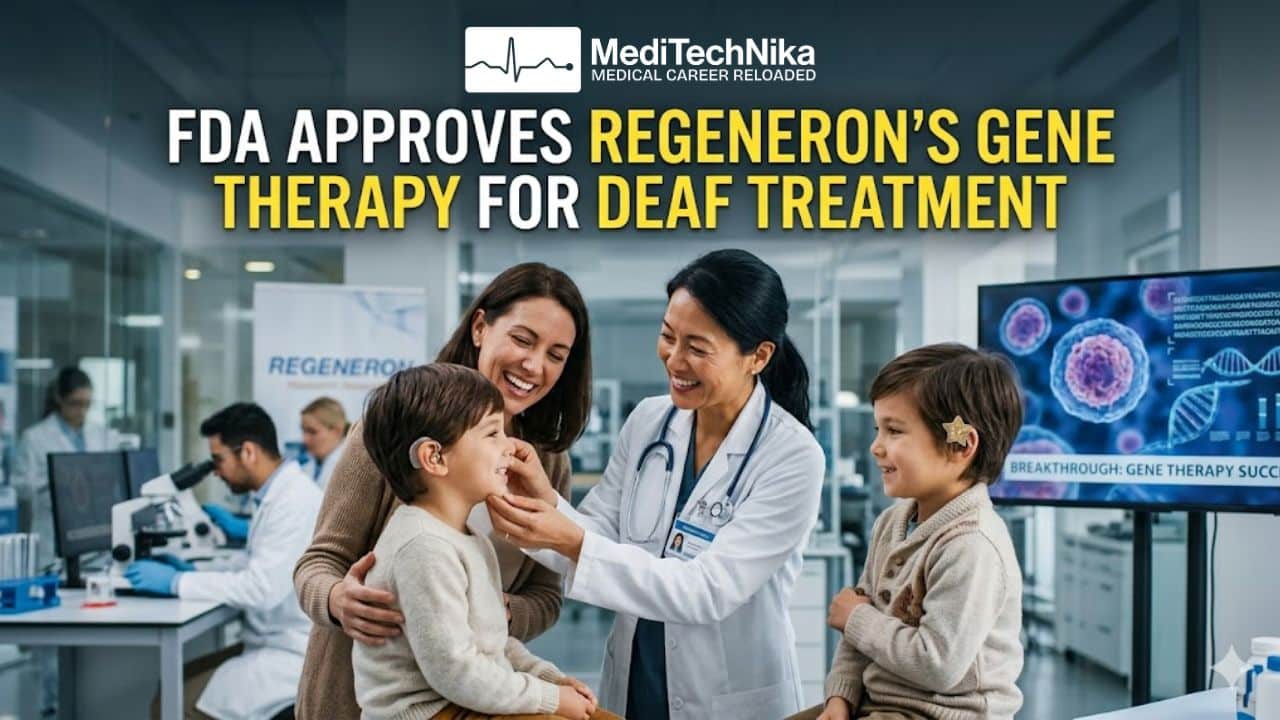
Regeneron’s Gene Therapy for Deaf Treatment
For many families, a child’s first response to sound, a laugh, a word, or even a turn of the head, marks a powerful emotional milestone. For those born with certain genetic forms of hearing loss, these moments are often delayed or never experienced. Until now, available options like hearing aids and cochlear implants have helped patients adapt, but they do not correct the underlying cause. A newly approved Gene Therapy for Deaf Treatment may begin to change that reality.
In a landmark decision, the USA Food and Drug Administration (FDA) has approved Otarmeni, a one-time gene therapy developed by Regeneron Pharmaceuticals, for individuals with severe-to-profound hearing loss caused by mutations in the OTOF gene. The therapy is also the first to be cleared under the FDA’s “national priority” voucher program, enabling an accelerated review pathway.
How does the Gene Therapy for Deaf Treatment Work?
OTOF-related hearing loss is a form of autosomal recessive, non-syndromic deafness (DFNB9). The OTOF gene encodes otoferlin, a calcium-sensitive protein essential for synaptic vesicle release in inner hair cells of the cochlea.
In normal physiology:
- Sound waves are converted into electrical signals by inner hair cells
- Otoferlin facilitates neurotransmitter release at ribbon synapses
- Auditory nerve fibers transmit signals to the brain
In patients with OTOF mutations:
- Synaptic transmission is disrupted despite structurally intact hair cells
- This results in auditory neuropathy spectrum disorder (ANSD)
- Patients typically present with severe-to-profound congenital hearing loss
This makes OTOF an ideal target for gene therapy, as restoring protein function can potentially re-enable natural hearing pathways.
Mechanism of Action
Otarmeni uses an adeno-associated virus (AAV) vector system engineered to deliver a functional copy of the OTOF gene directly into the inner hair cells of the cochlea.
Key technical aspects include:
- Vector type: Recombinant AAV (serotype optimized for inner ear transduction)
- Delivery route: Intracochlear injection via round window membrane or cochleostomy
- Expression target: Inner hair cells (IHCs)
- Therapeutic goal: Restore otoferlin expression and synaptic transmission
The procedure is performed under general anesthesia and has a surgical complexity similar to that of cochlear implantation. Unlike devices, this deaf treatment aims to restore endogenous auditory signaling rather than bypass it.
What the Clinical Trial Showed?
A clinical study involving 20 children aged between 10 months and 16 years supported the FDA approval. The results were promising:
- Around 80% of participants showed significant improvement in hearing within six months
- Many were able to detect sounds as loud as normal conversations
- Some children began responding to voices and environmental sounds within weeks
Eliot Shearer, one of the investigators, shared that children in the trial began responding to the voices of their parents and even enjoying music.
The therapy worker across different age groups. This suggests that the Gene Therapy for Deaf Treatment may not be limited to very young patients.
Safety and Early Observations
The treatment appears to be generally safe so far. Dizziness, Nausea, and temporary ear infections were some of the reported mild side effects.
Most side effects were short-lived and manageable, according to Lawrence Lustig. This could be the growing confidence around gene therapy as a viable approach for long-term conditions.
Why This Approval of Gene Therapy for Deaf Treatment Matters?
Otarmeni is the first gene therapy approved under the FDA’s “national priority” voucher program. This made it more significant and allowed a faster review process. This could help bring the treatment to patients soon.
Regeneron Pharmaceuticals has also announced that eligible patients in the USA will get this deaf treatment at no cost. But procedural expenses may still apply.
This development highlights how Gene Therapy for Deaf Treatment is no longer just an idea. This is becoming a real clinical option.
Challenges and Future
Despite its promise, several key challenges remain:
- Durability: Long-term persistence of hearing improvement is not yet fully established
- Variability in response: At least one patient showed minimal benefit, possibly due to delivery inefficiency
- Patient selection: Limited to individuals with confirmed OTOF mutations
- Anatomical constraints: Not suitable for ears already implanted with cochlear devices
Additionally, the prevalence of OTOF-related hearing loss is low, making this a niche but high-impact Gene Therapy for Deaf Treatment.
Competitive Landscape
The field of gene therapy for hearing loss is rapidly evolving. Multiple companies, including Eli Lilly, are developing similar inner ear gene therapies targeting different genetic causes of deafness.
This growing competition may:
- Expand treatment options across genetic subtypes
- Drive innovation in vector design and delivery systems
- Influence cost and accessibility over time
A New Chapter in Deaf Treatment
Even with these challenges, the approval signals a powerful shift in medicine. Instead of managing hearing loss, doctors may now be able to correct it at its source.
For many families, this Gene Therapy for Deaf Treatment represents more than just science; it’s about connection, communication, and experiencing the world in a completely new way.
As Regeneron and the FDA continue to push boundaries, this could be just the beginning of a new era in which gene therapy reshapes how we think about treating deafness.


