MYSM1 Genetic Disorder Treatment
For most children, tiredness after playing or studying is normal. But a 12-year-old boy and his family lived between hospital visits, blood transfusions, and uncertainty for many years. What started as weakness and severe anemia during infancy slowly turned into a long medical journey filled with unanswered questions. There has been a hope for his parents that one day, the doctors would finally find the real cause behind his worsening condition. They came up with India’s first rare genetic disorder treatment.
That answer came through advanced testing. The doctors identified a rare mutation in the MYSM1 gene. This is an extremely rare condition linked to bone marrow failure. There were fewer than 20 cases reported globally. But the diagnosis itself was a major challenge. But what followed became a landmark moment in Indian healthcare.
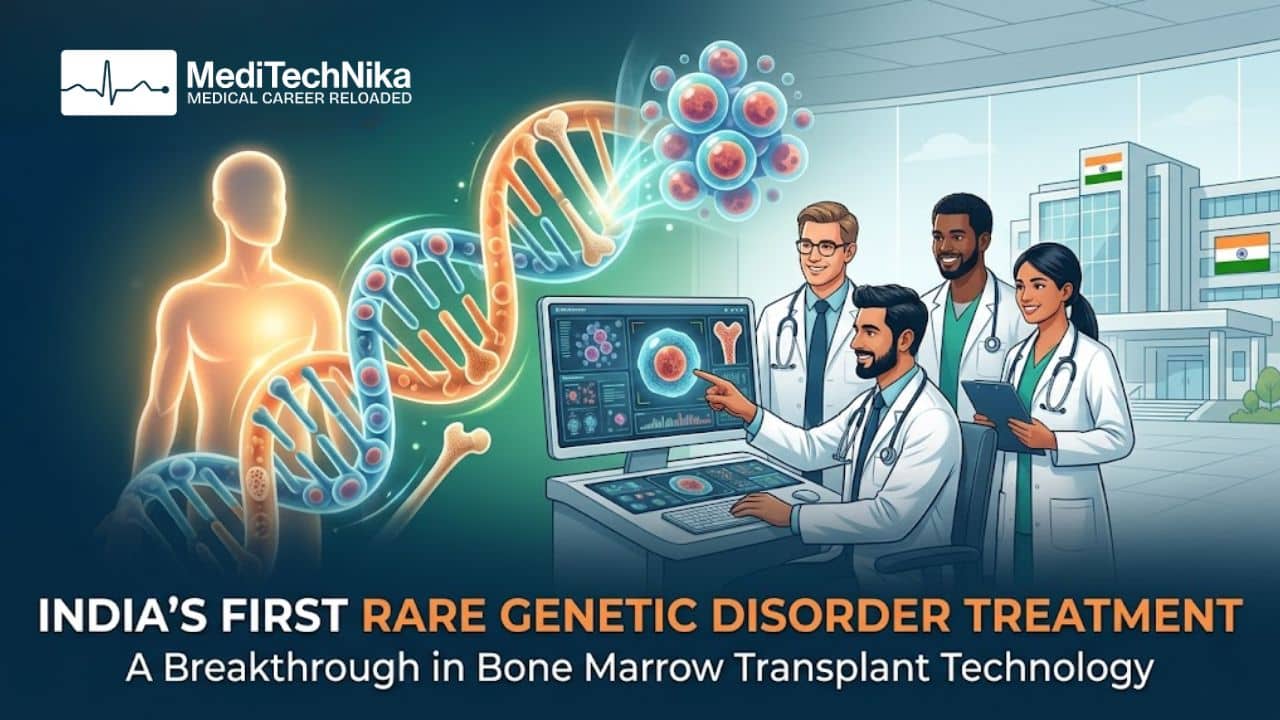
In India, the doctors have now successfully performed the country’s first known genetic disorder treatment for MYSM1-related bone marrow failure syndrome using a life-saving bone marrow transplant.
The child had been initially treated for Diamond–Blackfan anemia because of his symptoms. The doctors used this treatment as the symptoms closely matched the disorder. Steroids helped him for some time, but his health started declining again as he grew older. His anaemia became more severe. His platelet counts dropped. He needed frequent medical support.
Doctors discovered a mutation in the MYSM1 gene after a detailed genetic analysis and next-generation sequencing. This confirmed that the child was suffering from a rare inherited bone marrow disorder. There was no standard treatment plan to follow, as conditions related to the MYSM1 gene are extremely rare.
The boy underwent a haploidentical bone marrow transplant in January 2026. It is a procedure in which the parents become the donors. The stem cells were donated by his father, who was a half-match donor. Doctors used a specially modified low-intensity conditioning regimen before the transplant because of the rare genetic condition. The main goal was to reduce toxicity and side effects while ensuring that the donor stem cells were successfully transplanted into the child’s body.
The procedure required nearly three weeks of hospitalization inside a highly sterile isolation unit with continuous monitoring. According to the treating doctors, the transplant response was quicker than expected. Blood cell recovery began within 12 to 14 days after the procedure.
By day 30, tests confirmed 100% donor chimerism, meaning the donor cells had completely taken over blood formation in the child’s body. Importantly, doctors reported no major complications during recovery.
Today, the boy no longer spends his life inside hospital wards. He now visits the outpatient department only for routine follow-ups while gradually returning to normal daily activities.
Medical experts believe this successful treatment of a genetic disorder is an important milestone for India’s growing expertise in advanced genetic medicine and pediatric hematology. They also stress that timely genetic testing can play a major role in identifying rare disorders linked to the MYSM1 gene, especially in children with unexplained anemia or bone marrow failure.
The success of India’s first rare genetic disorder treatment also highlights how haploidentical transplants (when parents become donors) can offer hope even when fully matched donors are unavailable.
For the child’s family, however, the achievement is much more personal than it is in medical records or scientific reports. After years of fear and uncertainty, they are finally seeing their son live a healthier and more normal life. This was something that once felt impossible.