


Becoming a Medical Advisor After MBBS
What if you could make a high-impact medical career without spending the entire day in hospital wards? During MBBS, most career discussions revolve around postgraduate entrance examinations, residency, and clinical practice. However, patient-facing work is not the only way doctors can apply their medical knowledge. Medical affairs offers a distinct career path for doctors who are interested in clinical evidence, drug development, scientific communication, and the appropriate use of medicines. Are you interested in exploring a career as a Medical Advisor after MBBS? Read on…
A medical advisor works at the intersection of medicine, research, and the pharmaceutical industry. The role may involve evaluating clinical evidence, supporting medical strategy, reviewing scientific materials, and communicating with health care professionals. It is generally non-patient-facing and one of the pharma jobs for MBBS Doctors, but it remains a medical function with clear ethical, scientific, and compliance responsibilities.
This article explains how to become a medical advisor after MBBS, the qualifications employers may expect, the skills you need to develop, indicative salary considerations and the possible pharma career path in India.
Who Is a Medical Advisor?
A Medical Advisor provides scientific and clinical expertise within medical affairs. The role supports evidence-based medical strategy, scientific exchange, medical governance, and the appropriate use of medicines.
Medical advisors usually work within one or more therapeutic areas. Their responsibilities may include evaluating evidence, identifying medical needs, supporting scientific education, and engaging healthcare professionals for defined scientific purposes. These interactions must be accurate, balanced, transparent, and compliant with applicable requirements.
Similar positions exist in pharmaceutical, biotechnology, vaccine, medical device, and health technology organisations. This article primarily focuses on medical advisor roles within pharmaceutical medical affairs.
What Does a Medical Advisor Do?
The responsibilities of a medical advisor vary by company, therapeutic area, product, life cycle, and seniority. Typical responsibilities are:
-
Scientific Literature Review:
- Medical Advisors review clinical trials, treatment guidelines, systematic reviews, conference abstracts, real-world evidence, and drug safety information.
- They assess study quality, limitations, clinical relevance, applicability, and benefit/risk implications before translating the evidence into useful medical insights.
-
Scientific Engagement:
-
- They may engage health care professionals and external experts to discuss clinical evidence, treatment gaps, research questions, and medical education needs.
- Every interaction should have a documented scientific purpose and follow relevant transparency, conflict-of-interest, and compliance requirements.
-
Medical Strategy:
-
- Medical advisors contribute to medical plans for a medicine or therapeutic area.
- This may include identifying evidence gaps, research priorities, scientific education needs, and unanswered questions in clinical practice.
-
Internal Scientific Training:
-
- Medical Advisors help internal teams to understand the disease, treatment landscape and evidence behind a medicine.
-
Review Medical and Promotional Materials:
-
- Medical Advisors may review presentations, educational materials, and promotional materials for scientific accuracy, balance, substantiation, safety information, and alignment with approved product information, company SOPs, and applicable requirements
-
Medical Governance:
-
- Medical input must remain scientifically balanced and should not become disguised promotion or unsupported product advocacy. Medical advisors must be able to maintain the boundary between independent medical communication and commercial activities.
-
Safety-Information Escalation:
-
- If a medical advisor receives information about an adverse event, product complaint, or other safety concern, it must be documented and escalated according to the company’s pharmacovigilance procedures and timelines.
-
Scientific meetings and Research discussions:
-
- Medical advisors may support advisory boards, CME/CPD activities, scientific conferences, and investigative discussions. These activities require defined scientific objectives and appropriate governance. They are not simply networking events.
Although the role is a non-clinical career in many organisations, it remains a medical function that requires clinical credibility, scientific judgment, and ethical responsibility.
Can You Become a Medical Advisor After MBBS?
It is possible to enter medical affairs after MBBS, but eligibility is vacancy-dependent. Some employers consider MBBS graduates for junior medical or medical affairs positions. Others require a postgraduate qualification, clinical experience, therapeutic area expertise, or previous pharmaceutical industry experience.
An MBBS degree does not by itself guarantee eligibility or selection. Before applying, check the official job description for:
- Required medical qualification and registration
- Post-MBBS clinical experience
- Postgraduate qualification
- Medical Affairs or pharmaceutical experience
- Therapeutic-area knowledge
- Travel, location and fieldwork requirements
MBBS graduates can also examine adjacent positions such as Medical Affairs Associate, Junior Medical Advisor or certain medical-review roles. Requirements for Medical Science Liaison, Drug Safety Physician, Clinical Research Physician and similar positions vary considerably. These roles should not be automatically described as entry-level.
An adjacent role may help you build relevant competencies, but progression to medical advisor depends on the actual responsibilities, your performance, and available internal opportunities.
Skills Required for Medical Advisor Jobs
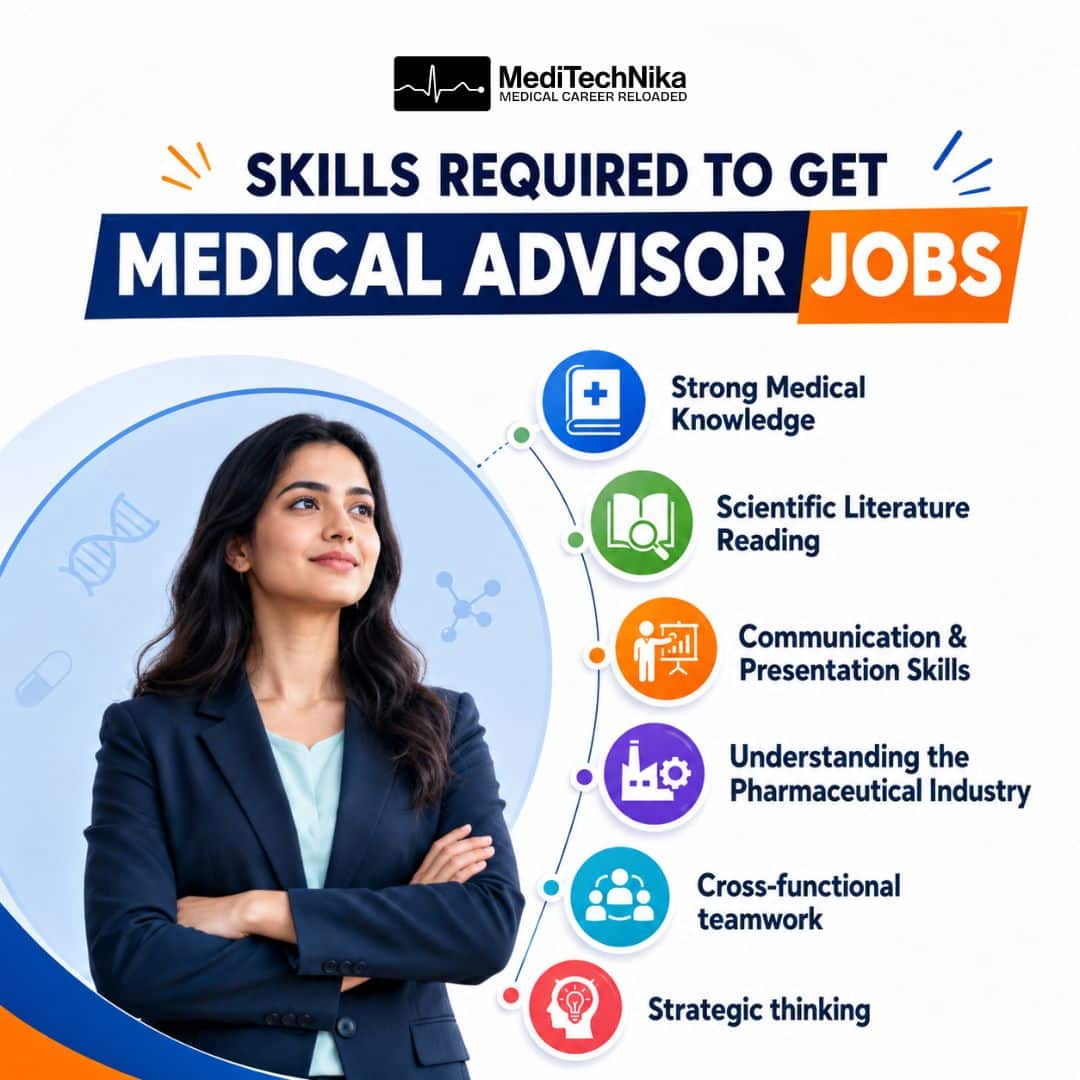
Your MBBS degree gives you the scientific foundation. But a doctor should develop skills to get into a pharmaceutical company for the Medical Advisor position.
-
Strong Medical Knowledge:
-
- You should have an understanding of pathophysiology, pharmacology, clinical medicine, therapeutics, drug safety, and evidence-based medicine.
- Once you join a therapeutic area, you should develop greater skills in that particular field.
-
Scientific Literature Reading:
-
- You should be comfortable with concepts such as study design, primary and secondary endpoints, randomisation, blinding, relative and absolute risk, confidence intervals, statistical significance, clinical significance, and bias and study limitations.
- You do not need to become a Biostatistician, but you should be able to critically evaluate clinical evidence.
-
Communication & Presentation Skills:
- You must be able to explain medicine clearly to people in medical advisor jobs. You have to explain complex clinical trial procedures to a senior specialist.
- Medical Affairs teams often prepare and deliver scientific presentations. Learn how to communicate a research process in a short presentation.
-
Understanding the Pharmaceutical Industry:
-
- You should understand the basics of Drug discovery, Clinical development, Regulatory affairs, Pharmacovigilance, Medical Affairs, Commercial functions, Drug lifecycle management, and Compliance and ethical scientific communication.
-
Cross-functional teamwork:
-
- You may collaborate with Medical Affairs, Regulatory Affairs, Pharmacovigilance, Clinical Research, Marketing, Sales, Legal and compliance teams.
-
Strategic thinking:
- Strategic thinking becomes increasingly important. You begin asking “What does this evidence mean for physicians, patients and our medical strategy?”
-
Compliance and Ethical Judgement:
-
- Important areas include balanced scientific communication, data integrity, confidentiality, conflict-of-interest awareness, adverse event escalation, and separation of medical communication from promotional activity
-
Project and Stakeholder Management:
-
- Medical advisors frequently manage deadlines, documentation, meetings, and cross-functional projects.
- They must be able to influence stakeholders professionally and challenge claims that are inaccurate, unbalanced, or unsupported.

How to Become a Medical Advisor After MBBS: A Step-by-Step Guide
So, you have decided to explore Medical Advisor Jobs. But where should you begin?
Moving from a hospital or medical college environment into a pharmaceutical company can be confusing at the start. Good news is that you have the most important foundation: your medical knowledge. Next, you need the right combination of industry knowledge, evidence-appraisal skills, communication ability and a targeted job-search strategy.
Step 1: Use Your MBBS as Your Foundation
During your MBBS and clinical postings, you learn how diseases occur, why treatments are selected, how medicines affect patients, and how doctors make clinical decisions. This real-time understanding becomes valuable when you later discuss clinical evidence or therapies in the pharmaceutical industry.
So your MBBS degree is not just an eligibility requirement, but the clinical knowledge you have is the foundation for building a rewarding pharma career.
Step 2: Understand How the Pharmaceutical Industry Works
As MBBS doctors, before applying for any pharma jobs, you have to spend more time understanding the different departments within the pharmaceutical company. You should know the basic functions of the following,
- Medical Affairs: Handles the scientific exchange, medical education, evidence generation, and medical strategy.
- Clinical research: Focuses on generating clinical evidence through clinical studies and trials that are conducted in a company.
- Pharmacovigilance: Basically deals with drug safety, adverse event monitoring, and benefit-risk evaluation.
- Regulatory affairs: Works on regulatory submissions, approvals, and compliance.
- Commercial and Marketing Department: Focuses on business and promotional aspects of pharmaceutical products of the company with applicable regulations.
So why does this matter? Because during an interview, you just can’t simply say, “I want to work in a pharma company,” and that will not be enough either. Rather, you should be able to explain why medical affairs interests you and how you can make a difference in the sector.
In India, candidates should develop a basic understanding of UCPMP 2024, applicable CDSCO requirements, relevant ICH guidelines, pharmacovigilance responsibilities, and company SOPs.
Step 3: Strengthen your Clinical research and Evidence-based Medicine skills
Scientific evidence is something medical advisors spend more time working with. Therefore, they need to learn how to read and critically evaluate research papers. Select a recently published clinical trial and examine its research question, study design, population, comparator, endpoints, and results. Then assess statistical significance, clinical relevance, limitations, applicability, and benefit-risk implications. This exercise is more useful than simply memorising the study conclusion.
Step 4: Develop the Skills Pharma Companies Look For
Having an MBBS degree gets your profile noticed, but the skills you have can determine whether you could move further in the hiring process or not. You have to focus on developing the following skills,
- Scientific Communication: You must learn to explain complex medical or scientific information in simple language without losing accuracy.
- Presentation Skills: Practice presenting clinical research, treatment guidelines, and disease concepts using short and clear presentations.
- Medical Writing: Improve your ability to summarise research papers and communicate scientific information efficiently.
- Literature Review: Be comfortable in finding reliable information from sources such as PubMed, Medical journals, clinical guidelines, and peer-reviewed journals.
- Evidence Interpretation: Develop enough statistical understanding to interpret study results correctly. Identify uncertainty and know when input from a statistician or methodology expert is required.
- Professional communication: Clear speaking and active listening matter more. A medical advisor interacts with specialists, researchers, and cross-functional teams to convey various information.
Step 5: Create a Pharma-Focused CV
A common mistake every MBBS graduate makes is using the same CV for various positions. Your CV for a medical advisor job should highlight skills and experience in medical affairs.
If you don’t have medical affairs experience, don’t claim it. Highlight transferable evidence such as clinical expertise, presentations, audits, publications, literature reviews, research exposure, medical writing, and relevant training. Use specific examples instead of broad statements such as “excellent communication skills”.
Step 6: Don’t search only for the Medical Advisor Role
You cannot expect to have the job title “medical advisor” in your first pharmaceutical job. And that’s absolutely fine. When you are searching for opportunities, you can use related titles such as:
- Medical Advisor
- Junior Medical Advisor
- Medical Affairs Associate
- Medical Science Liaison
- Medical Reviewer
- Drug Safety Physician
- Scientific Advisor
- Clinical Research Physician
- Medical Writer
Your career roadmap could be:
MBBS → Entry-Level Pharma Role → Medical Affairs Experience → Medical Advisor → Senior Medical Advisor → Medical Affairs Leadership

Step 7: Build Your Network
LinkedIn may help you connect with professionals currently working as medical advisors, medical science liaisons, medical managers, medical affairs managers, and directors. A meaningful professional connection can teach you far more than sending thousands of random messages asking for referrals.
Step 8: Apply Strategically for Medical Advisor Jobs
Don’t measure your job search by the number of applications that you have submitted. Measure it by the quality and relevance of those applications. Before applying for any job, read the complete description and check Educational and experience requirements, Therapeutic area, responsibilities, and travel expectations.
If you are a fresher and the position you want to apply for requires several years of experience in medical affairs, you can look for a more suitable entry point instead of becoming discouraged.
You can set job alerts using multiple keywords and regularly check pharmaceutical company portals’ career pages for alerts. Also, you can follow MediTechNika job updates for relevant opportunities for medical professionals. Wherever possible, verify the eligibility, deadline, and application process through the employer’s official vacancy page before applying.
Step 9: Prepare specifically for pharmaceutical interviews
A medical advisor interview can be quite different from a clinical viva. You can be evaluated on:
- your medical knowledge
- clinical research understanding
- literature review
- communication skills
- presentation ability
- the way you understand medical affairs
- problem solving
- behavioural situations
- and ethical judgment
Before attending an interview in any company, research the therapeutic areas and understand the role described in the job description. Avoid answers such as:
- I don’t like hospital work
- I am frustrated because of the working hours
- I am feeling a lot of burnout in the hospitals
Instead, you can explain what attracts you to Medical Affairs, scientific communication, evidence-based medicine, drug development or medical strategy.
Step 10: Keep learning even after your first pharma job
Getting your first pharma job is only the beginning. Medicine changes, guidelines change, new clinical trials are published, and new safety information emerges. A successful Medical Advisor after MBBS needs to keep learning throughout their career.
You should have a habit of following:
- major medical journals
- clinical practice guidelines
- important clinical trials and drug safety updates
- medical conferences
- development in your therapeutic area
The stronger your combination, the more opportunities you can create for yourself.
Medical Advisor Salary in India
Now comes the most interesting question almost every MBBS graduate can ask: How much can I earn in this medical advisor role? There is no single medical advisor salary in India.
Compensation may depend on company, location, experience, therapeutic area, and qualifications.
Entry-level Medical Advisor jobs should not be compared directly with medical advisor, senior medical advisor, or global medical advisor roles. These titles may involve substantially different responsibilities and seniority. Until a reliable India-specific source is available, it is safer to evaluate compensation using the complete vacancy, including fixed salary, variable pay, benefits, travel requirements, and total responsibilities, rather than publishing a broad or unsupported salary range.
Indicative Career Progression
| Career Stage | Possible Roles | What Usually Changes |
| Entry into pharma | Medical Affairs Associate, Medical Reviewer, MSL or junior medical role | Learning industry processes and building experience |
| Early Medical Affairs career | Medical Advisor | Greater scientific and therapeutic responsibility |
| Experienced level | Senior Medical Advisor / Medical Manager | Strategy, stakeholder management and project leadership |
| Leadership | Medical Lead / Medical Affairs Head / Director | Team, portfolio and organisational leadership |
Career Growth After Becoming a Medical Advisor
Career progression is not identical in every company. A simplified progression can look like:
- Medical Affairs Associate or another suitable entry role
- Medical Advisor
- Senior Medical Advisor or Medical Manager
- Medical Lead
- Medical Affairs Head or Director
As your career progresses, your value increasingly comes from combining medical credibility with strategic and leadership ability.
Is an MD degree necessary to become a Medical Advisor?
An MD is not universally mandatory, but an MBBS degree alone does not qualify a candidate for every medical advisor vacancy.
Some vacancies may prefer candidates with postgraduate qualifications such as an MD in Pharmacology or Clinical Pharmacology, particularly when deeper therapeutic expertise is required.
But do not assume no MD = no Pharma career. Instead, you can evaluate each job description individually. MBBS graduates can strengthen their candidacy through relevant clinical experience, evidence appraisal, industry knowledge and communication skills.
Medical Advisor vs Medical Science Liaison
Although responsibilities vary between companies, an MSL is generally more field-facing and spends significant time engaging external healthcare professionals. A medical advisor may have a broader strategic role involving internal medical affairs activities, scientific planning, evidence interpretation, and cross-functional collaboration.
Both are normally non-promotional medical affairs functions. They may collaborate with commercial colleagues, but scientific exchange must remain balanced and follow defined governance boundaries. Always evaluate the actual job description rather than relying only on the title.
Other Pharma Jobs for MBBS Doctors
Medical Advisor is not the only option. If you are exploring Pharma jobs, you can consider:
- Medical Science Liaison: Suitable for doctors who enjoy scientific conversation, networking, and field-based work.
- Pharmacovigilance Physician: Focus is on adverse events, drug safety information, and benefit-risk assessment.
- Medical Reviewer: Involves reviewing clinical or medical information for accuracy and relevance.
- Clinical Research: Contribute to clinical trials and medical oversight depending on the position.
- Medical Writing: Suitable for those who enjoy turning complicated scientific information into clear medical content.
- Medical Affairs: Broader roles may involve scientific communication, evidence generation, and medical strategy.
These roles provide flexibility for MBBS graduates, which is one of the major advantages of entering the pharmaceutical industry.
Who Should Consider a Medical Advisor Career?
This path is suitable for those who:
- Want to remain connected to medicine in a non-clinical career
- Enjoy reading and evaluating clinical evidence
- Are interested in pharmacology and drug development
- Can communicate complex scientific information accurately
- Are comfortable presenting to scientifically informed audiences
- Can work within ethical and compliance boundaries
- Enjoy cross-functional and project-based work
- Are prepared for continuous learning.
You have to think carefully if your greatest motivation is examining patients, performing procedures, or practising bedside medicine every day. Medical affairs remains medically demanding, but it’s not a substitute for clinical practice. It is a different profession built on the same scientific foundation.
Common mistakes MBBS graduates make while entering Pharma
- Applying without understanding medical affairs
- Ignoring communication skills
- Applying for only the medical advisor titles
- Expecting an instant hike in salary
- Treating medical affairs like pharmaceutical sales
A Simple 90-Day Preparation Plan
A 90-day plan can help you prepare systematically, but it does not guarantee that you will secure a medical advisor position within 3 months.
Days 1-30: Understand
Learn the fundamentals of medical affairs, drug development, clinical trials, pharmacovigilance, regulatory fundamentals, and evidence-based medicine. In the Indian context, develop introductory awareness of UC PMP 2024, applicable CDSCO requirements, ICH guidance, and company SOPs.
Days 31-60: Practice
Choose one therapeutic area that you are interested in. Summarise its design, results, limitations, clinical relevance, and benefit-risk implications. Create a short presentation using only public or properly de-identified information. Never use confidential patient or company data.
Days 61-90: Enter the Market
Use this phase to refine your CV, LinkedIn profile, interview preparation, professional network, and job search strategy. Practice scenarios involving evidence, balance, adverse events, escalation, conflicts of interest, and medical-commercial boundary.
Apply only where your profile reasonably matches the stated requirements. Measure your progress by the relevance and quality of your applications, not simply by the number submitted.
Looking ahead
Your MBBS degree is a beginning, not a boundary. A medical advisor role illustrates one possible non-clinical career path for eligible MBBS graduates who want to work with clinical evidence, medical strategy, and the responsible use of medicines.
MediTechNika can help professionals discover relevant job updates, practical career information, and industry-focused learning resources for Medical Advisor After MBBS. Always confirm qualifications, registration requirements, responsibilities, and application instructions through the employer’s official vacancy before applying.
Your medical degree is powerful, but knowing where and how to use it can make all the difference.


