


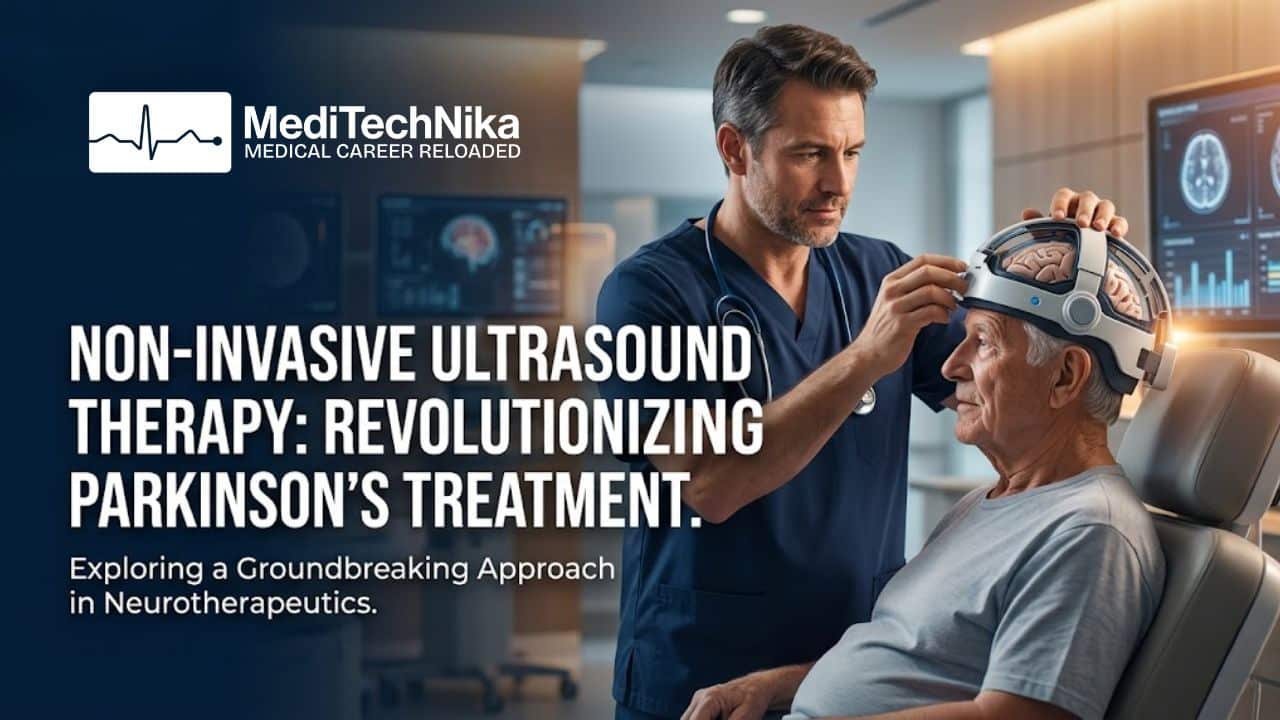
Non-Invasive Ultrasound Therapy for Parkinson’s Disease Treatment
Daily life slowly becomes a battle for many people living with Parkinson’s disease. Right from buttoning a shirt to holding a coffee cup steady or speaking even clearly becomes difficult. Brain Surgery is the current treatment, but it has many difficulties. A New study gives hope that the future of Parkinson’s disease is not so difficult. Researchers at the University of Oxford have, for the first time, shown that Non-invasive Ultrasound therapy can directly affect brain activity in people living with Parkinson’s disease.
Non-invasive Ultrasound therapy is similar to deep-brain stimulation (DBS). But Deep-Brain Stimulation is a widely used invasive surgical procedure. The new treatment method was published in Nature Communications. This could be a turning point in approaching Parkinson’s disease treatment.
What is the Challenge of Parkinson’s disease?
Parkinson’s disease affects approximately 8.5 million people around the world. It is a progressive neurological disorder. It is caused by the loss of dopamine-producing neurons in the brain. The symptoms include tremors, slowed movements (bradykinesia), muscle stiffness, and difficulty speaking.
Deep Brain Stimulation involves implanting electrodes into the brain. This could help manage the symptoms of Parkinson’s disease. But this is not accessible or affordable for many, especially in low- and middle-income countries.
Limitations of Deep Brain Stimulation
DBS delivers high-frequency electrical stimulation (typically ~130 Hz) to deep brain nuclei such as the subthalamic nucleus (STN) or globus pallidus internus (GPi). While effective, DBS has several limitations:
- Requires invasive neurosurgery with electrode implantation
- Risk of complications such as hemorrhage, infection, and hardware failure
- High cost and limited accessibility globally
- Suboptimal targeting in some patients due to anatomical variability
These challenges highlight the need for alternative Parkinson’s disease treatment strategies that are both effective and scalable.
A New Approach
A non-invasive approach does not require any surgical procedures, unlike traditional treatments. Researchers used ultrasound waves to target deep brain regions involved in movement control.
Ultrasound waves were carefully directed through the skull to reach specific parts of the brain. The researchers used 130 Hz, the same frequency used in DBS. This could closely replicate its therapeutic effects.
They also used personalized ultrasonic lenses for each patient, using advanced computational models to make this treatment more precise. These lenses targeted the globus pallidus, which is important for regulating movement.
Mechanism of Non-Invasive Ultrasound Therapy
The study explores Non-invasive Ultrasound therapy, specifically low-intensity transcranial focused ultrasound stimulation (tFUS), as a neuromodulation tool.
Unlike ablative focused ultrasound used in lesioning procedures, this approach operates at sub-thermal intensities, enabling reversible modulation of neuronal activity. The technique relies on:
- Acoustic pressure waves are transmitted through the skull
- Mechanical interaction with neuronal membranes (mechanosensitive ion channels)
- Modulation of synaptic activity and network oscillations
In this study, ultrasound stimulation was tuned to mimic DBS-like parameters, particularly a pulsed frequency of 130 Hz, to target Parkinsonian circuitry.
Promising Early Results
Although the study involved only four patients, the results were encouraging:
- A reduction of abnormal beta brain oscillations by around 10%
- An improvement in reaction time by nearly 18%, indicating better movement control
- Real-time changes in brain activity, showing a direct link between stimulation and effect
These findings suggest that Non-invasive Ultrasound therapy can directly influence the abnormal brain signals associated with Parkinson’s, something that had not been clearly demonstrated before.
Key Findings and Quantitative Outcomes
The study provides several important data points:
- ~10% median reduction in beta-band oscillatory power across basal ganglia circuits
- ~18% median improvement in reaction time, reflecting reduced bradykinesia
- Immediate onset of effects during stimulation, indicating a direct causal mechanism
- Network-level modulation observed beyond the primary target, suggesting circuit-wide impact
These findings establish that Non-invasive Ultrasound therapy can modulate a clinically validated biomarker of Parkinson’s disease in a controlled and reversible manner.
Why This Non-invasive Ultrasound Therapy Matters?
One of the key problems in Parkinson’s disease treatment is targeting the right brain region for each patient. Even with DBS, doctors do not always know in advance which area will give the best results.
According to Alex Green, co-author of the study, this technology could help personalize treatment. By testing different brain targets non-invasively, doctors may be able to identify the most effective approach before considering surgery.
Lead author John Eraifej also highlighted that this method could extend beyond Parkinson’s, opening the door to treating other conditions such as chronic pain and tinnitus.
The Future
The researchers plan to refine this technique further and explore its use in larger clinical trials. If this Non-invasive Ultrasound therapy turns out to be successful, it will become a widely accessible option for Parkinson’s disease treatment.
Beyond therapy, it may serve as a tool to guide brain surgeries more accurately. This could improve outcomes for patients who require invasive procedures.
A Quiet but Powerful Change
This study is still in its early stages. This requires a lot of research. But the idea of sound waves rather than scalpels is both powerful and promising.
This way of Parkinson’s disease treatment is safer and simpler for millions of people. This offers something that medicine always strives to deliver.
You don’t just get a longer life, but a better quality of life!